
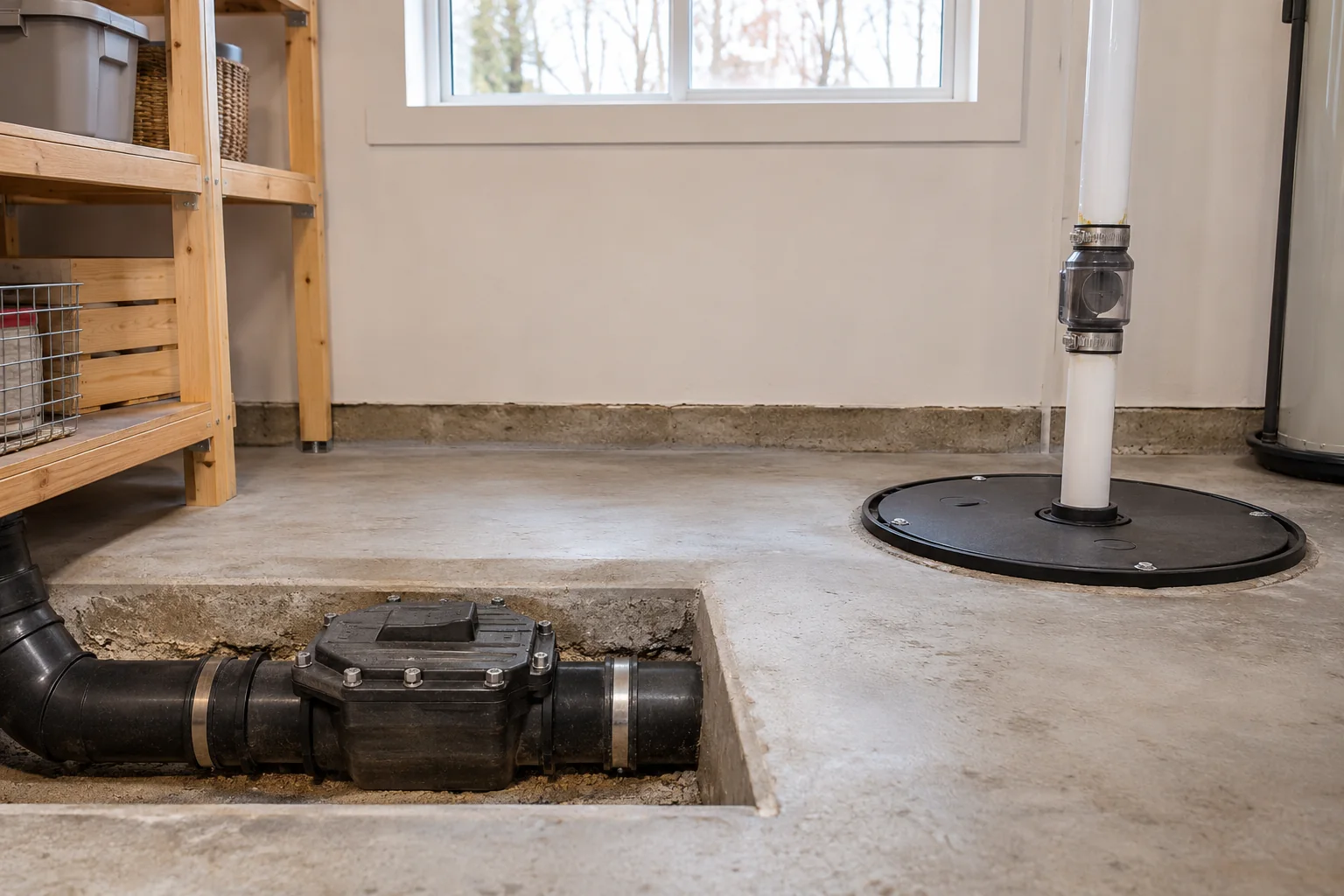
Backwater valve vs sump pump: which protection does your basement need? These devices may sit in the same room, but they answer different questions. A backwater valve limits reverse flow through a protected drainage pipe. A sump pump removes water that reaches its basin. Before choosing either device, identify the water pathway and the problem you need the installation to address.
This guide helps homeowners, condominium owners and property managers prepare that decision in LaSalle and Greater Montréal. It compares the functions, limitations and questions worth asking. It does not provide a connection plan to copy. A basement that stayed dry during a small storm, a pump that makes noise, or a cover in the floor cannot establish the actual extent of a building’s protection.
Key takeaways
- A valve blocks reverse flow. Its location determines which pipes and fixtures receive protection.
- A pump removes collected water. The basin must receive that water, and its discharge route must remain usable.
- You may need both. Sewer protection does not eliminate water arriving around the foundation.
- The building determines the solution. Connections, elevations, water use and local requirements matter more than a product comparison alone.
1. Start by following the water pathway
Write down what you actually observed. Was water rising from a drain, crossing a doorway or appearing along the bottom of a wall? Record the sequence as well. “The pit level rose before the spill” provides a different starting point from “the toilet overflowed while the pit stayed at its usual level.” These observations help direct the assessment. However, they do not establish the diagnosis.
Colour and smell cannot establish that water is safe. For example, water that looks clear may have passed through contaminated drainage. Do not touch it to identify its source. If you discovered a puddle only after the event, record that its entry point remains unknown. An honest gap in the history is more useful than an assumed source that sends the investigation in the wrong direction.
Next, prepare three questions: where does the water come from, how can it enter the building, and where should it go? In a house with an addition, the answers may differ between the original building and the newer section. In a plex, equipment accessible from one dwelling may serve shared drainage. Therefore, ask the professional to identify the connections before assigning a purpose to every floor cover.
2. What a backwater valve protects
A drainage backwater valve controls the direction of flow. It allows intended discharge and resists water returning through the pipe where it sits. The RBQ’s guidance on protection against sewer backups, in French, refers readers to a technical sheet developed with the CMMTQ. The valve type and its position must suit the drainage system concerned.
Consequently, seeing one valve does not prove that every fixture has protection. Ask specific questions: does this shower connect on the protected side? Does the garage drain join the same branch? What happens to discharge from upstairs? A simple sketch based on verified connections can make the answer easier to understand. It should also identify any pipe sections that remain unknown beneath the slab.
The RBQ–CMMTQ technical sheet on backwater valves, in French, distinguishes valve types and explains constraints involving air circulation and permitted configurations. It does not justify automatically putting a valve on the main building drain. For an assessment of existing equipment, see our backwater valve service. This guide helps you frame the decision that the assessment needs to resolve.
3. What a sump pump does
A sump pump moves water from a collection basin to a discharge destination. In a foundation drainage system, water must first reach that basin. The pump cannot automatically collect every patch of water beneath the slab or behind a wall. The Government of Canada explains the basin, float switch and discharge pipe as parts of the complete system.
In practical terms, “submersible” describes a feature of a pump rather than its complete intended use. A drainage pump, sewage lifting equipment and a temporary construction pump are not interchangeable simply because they fit inside the same opening. When requesting a visit, provide the model information you already have and explain what you know about its use. Do not call it a sewage system solely because a pipe disappears beneath the floor.
To compare proposals, ask what incoming water the pump must handle and how the discharge route has been assessed. The professional needs to consider the actual arrangement, rather than choosing only by the power rating on a box. Our sump pump service page explains possible interventions. An assessment may lead to a discharge correction instead of an automatic pump replacement.
4. Backwater valve vs sump pump: compare the roles
| Question | Drainage backwater valve | Sump pump |
|---|---|---|
| Main action | Resists reverse flow through a protected pipe | Removes water collected in the basin |
| Essential question | Which fixtures actually have protection? | What reaches the basin, and where can it discharge? |
| Limitation to plan for | Closure may temporarily prevent protected fixtures from draining | Pumping depends on power, equipment and a usable discharge route |
| Shared need | Access and maintenance | Access and maintenance |
A separate check valve may sit on the pump’s discharge pipe. It helps stop pumped water from returning to the basin after the pump stops. However, that does not establish protection for toilets or floor drains against a sewer backup. Ask the professional to name each valve by the pipe it serves. This avoids the misleading shortcut: “There is already a check valve, so the basement must be protected.”
A backflow prevention device for drinking water has another purpose again. The RBQ distinguishes potable-water backflow prevention devices, in French. Their verification requirements cannot simply be transferred to wastewater valves because the names sound similar. When calling, specify whether your concern involves drinking water, the sewer, or foundation drainage. That distinction helps avoid arranging the wrong type of visit.
5. When both protections need one coordinated plan
Imagine a basement where the drainage system experiences reverse flow while water from the surrounding ground keeps arriving. Closing a backwater valve may address the first pathway. However, it does not remove the second inflow. The assessment must therefore establish what happens in the pit and which outlet remains available. This explains why the right decision may involve coordinated protections rather than an exclusive choice between two devices.
The bilingual Dollard-des-Ormeaux prevention leaflet describes an example involving separate sanitary and storm sewers, a valve and a pump. It illustrates how the functions can complement one another. It does not determine which connection is permitted in LaSalle, Laval or another municipality. A pipe heading “towards the street” is not enough to identify the receiving network.
Ask the professional to explain normal operation and surcharge conditions separately. Where does foundation drainage go if its usual outlet cannot accept the water? What prevents reverse flow through that route? Which fixtures must occupants stop using? The explanation should connect the indoor plumbing, collection system and discharge destination. Adding equipment without tracing those relationships can leave an important water pathway unresolved.
6. A closed valve changes how occupants can use plumbing
When a valve blocks reverse flow, wastewater generated on its protected side may temporarily have nowhere to drain. Adding more water can then create an overflow inside the building. The federal backwater valve guidance recommends limiting high-volume water use during heavy rain and discusses valve-closure alarms. Ask for instructions that match your actual connections.
In a shared building, those instructions need to reach other occupants. A basement tenant may have no control over an upstairs washing machine. Therefore, prepare a short instruction with the owner or manager: which uses must stop, who should receive the report, and who confirms normal use can resume? The instruction should not ask residents to open a cover or manipulate a valve during a backup.
Flat roofs also need attention when their drainage joins sanitary wastewater inside the building. Montréal identifies the risk of self-flooding in some older plexes in its heavy-rain building protection guidance, in French. Rainfall cannot be paused like a laundry cycle. Consequently, show the roof-drain connections to the professional before approving a modification that could close a drainage route.
7. Three situations that clarify the decision
Water rises through the shower during a storm
The first question concerns the shower’s drainage route and its protection. A sump pump elsewhere in the basement does not answer that question. Record other affected fixtures and the approximate time of the rise, without running them to recreate the problem. Once the site is safe, ask whether the assessment needs to investigate an obstruction, failed protection or an unprotected connection. The storm provides context; it does not prove municipal responsibility.
The pit level rises while the pump remains silent
This observation directs the call towards the pumping system, power supply and discharge. However, it does not identify a replacement part remotely. A new sewer backwater valve would not remove water already collected in the basin. Mention any known power outage and whether an alarm is operating. Stay in a dry location. An emergency is not the time to reach behind equipment for a plug or reset a breaker exposed to water.
Water crosses the garage doorway
The observed pathway is over the surface. A valve inside a drainage pipe does not seal that doorway. Similarly, a pump is not a reason to ignore incoming surface water. Have the opening, elevations and drainage of the area assessed together. Ask for a proposal that identifies this pathway rather than making a broad promise to “protect the basement.” Several entry routes can require several coordinated measures.
8. Check the requirements for LaSalle and the actual address
Montréal’s guidance on valves and collection pits describes obligations involving new buildings and previous flooding or sewer backup. It discusses protecting basement fixtures or groups of fixtures and ideally checking valves twice yearly. Access must remain available. Ask the professional to confirm requirements for your project rather than treating a general municipal explanation as a universal connection plan.
In LaSalle, the borough permit counter is the reference point for permit information and applications. Provide the address and describe the work: opening a slab, adding a pit, changing a discharge route or modifying a connection. Establish which documents, permissions and inspections apply before work begins. A maintenance visit and a new drainage connection should not be treated as identical projects without checking.
For a property elsewhere, consult its municipality. A method accepted in Montréal does not automatically apply to another address. Receiving networks and discharge conditions can differ. If financial assistance is part of the plan, verify the current program conditions and application timing before committing to work. Keep the response you receive. A program’s existence does not guarantee eligibility or reimbursement for equipment chosen in advance.
9. Discharge, power and alerts belong in the same decision
Before adding a pump, ask where water normally goes and how the system behaves if that destination becomes unavailable. The proposal should distinguish a verified connection from an assumed one. For an outdoor discharge, have the site constraints and local requirements checked. Moving water without understanding where it ends up can move the problem to another part of the property rather than resolve it.
The main electric pump and its backup arrangement need to be considered together. Two devices using the same power source do not provide protection against the loss of that source. Ask what takes over, what limitations apply and how the owner receives a warning. A promised runtime without operating conditions provides little basis for a decision. Consider the usual inflow pattern and how long the property may remain unattended.
An alarm supplies information; it does not replace pumping or reverse-flow protection. The Government of Canada explains the abilities and limitations of water alarms. Distinguish a high-water alarm in the pit, a valve-closure indicator and a sensor on the floor. Then decide who receives the signal and who can respond. A notification received while travelling does not, by itself, arrange access to the building.
10. Compare quotations with the same scope
Ask each quotation to begin with the problem it addresses. “Install a pump” describes an object; “remove water from this pit when this outlet is unavailable” describes the intended result. Ask for the findings, remaining unknowns and proposed solution. This allows a useful discussion of the choice without assuming that a longer or more expensive proposal must be better.
- Drainage system: identify protected fixtures, incoming water and the discharge destination.
- Work: describe openings, connections, equipment and required modifications.
- Restoration: assign concrete work, floor finishes, site protection and debris removal.
- Return to use: specify checks, accessible covers, operating instructions and model information.
- Follow-up: clarify maintenance, warranty limits and documents requested by the municipality.
Also ask what remains outside the price. Does the quotation include restoring the floor? Will a separate electrician be needed? Who checks permissions? Agree on how you will make a decision if a hidden pipe differs from the expected arrangement. A written scope reduces misunderstandings while leaving room for findings on site. No single advertised price can accurately represent every building configuration.
For a condominium or rental property, identify who can approve the work before the visit. For example, the person providing basement access may not have authority to modify a shared pipe. Record the decision-maker, access arrangements and any required coordination with residents. This is especially helpful when comparing a small accessible repair with a project that affects several dwellings or requires a floor opening.
11. During an incident, stay clear of the hazard
Do not cross water to reach a panel, outlet or pump. Hydro-Québec’s water-damage safety instructions give strict conditions for touching the main breaker and identify 1 800 790-2424 as the number to call when the electrical situation needs to be made safe. Call 911 for immediate danger. Do not open a cleanout or valve on a drainage system that is backing up.
When calling, describe the current situation before discussing future prevention work. Our sewer backup service concerns that immediate intervention. Comparing protective equipment comes after the incident is under control. For procedures involving private or public pipes, use our guide to preparing a sewer record. A protection that needs improvement does not, by itself, decide who is responsible for damage.
Frequently asked questions
Can I remove my backwater valve after installing a pump?
Do not assume so. Their functions differ, and the valve may protect fixtures that do not drain into the basin. Have the connections and requirements checked before removing anything. The proposal should explain how each relevant pathway remains addressed, including periods when pumping or the usual drainage route is unavailable.
Does a basement with no known flooding history need an assessment?
It can, especially before you conceal access points or change fixtures. No known incident does not establish the condition or extent of existing protection. Gather available documents and describe what has changed. The assessment may confirm useful existing equipment rather than automatically recommending another installation.
What should I ask about when buying a home?
Ask for access locations, equipment model details, installation documents and any reported water events. Distinguish the seller’s account from items a professional has actually checked. A photograph of a cover or an old invoice does not prove current operation. Arrange access to shared areas when the building contains more than one dwelling.
Should I start by replacing both devices?
Start by identifying the weakness and applicable requirements. The result may involve maintenance, a connection correction, discharge improvements or a targeted replacement. Ask why each task appears in the proposal and which risk it addresses. Keep that explanation with the invoices for future occupants and maintenance visits.
Prepare for a useful assessment
To discuss your installation, call Plomberie LaSalle at 514 312-3198. Provide the address, observed symptoms and known equipment, then confirm availability. Use the Contact page for a planned request. Explore our plumbing tips and the Maintenance and prevention category for further preparation.
Official sources consulted on November 4, 2026 appear in the guide’s links. The comparison scenarios are explanatory examples rather than diagnoses. Municipal requirements and actual connections must be confirmed for the property concerned.