
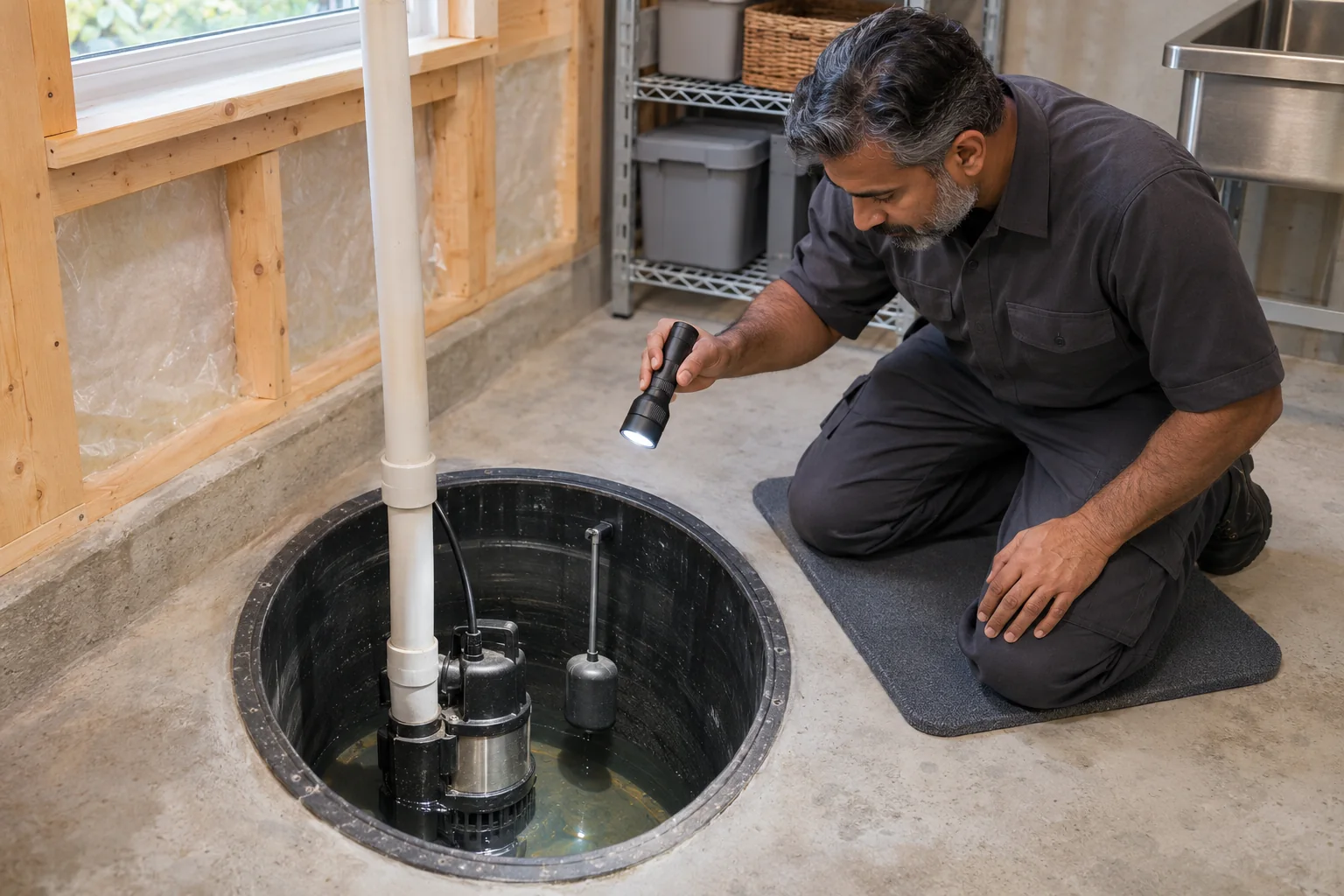
A useful sump pump inspection checklist starts with a clear record: what you noticed, which equipment is installed and what you want the visit to establish. You do not need to dismantle the pump or create a power failure to prepare. Specific observations help more than a guessed diagnosis. This guide is for homeowners, condominium owners and property managers arranging an inspection before snowmelt, after unusual operation or following changes to a building.
The aim is to follow the entire system, from incoming water to its discharge, then understand the tests and any remaining limits. Our sump-pump service page explains the available interventions. This guide focuses on preparing for that visit: equipment records, safe observations, questions about backup power, and the information to request in the inspection report. Keep your notes together so the person attending the appointment can explain the situation without relying on someone else’s memory.
What to remember before the visit
- Safety comes before documentation. Rising water near electrical equipment calls for a safe response, rather than a test.
- Observe without changing the system. Record unusual sounds, alerts and visible changes from a dry location.
- Bring equipment information. Model details, invoices, manuals and past reports give symptoms a useful context.
- Ask for written findings. A successful start alone does not establish pumping capacity, backup performance or a suitable discharge route.
1. Separate a planned inspection from an active emergency
If the basin is rising now, water is overflowing or you notice a burning smell, say so at the beginning of the call. Do not describe the request as routine seasonal maintenance. Explain where you are and what remains visible without entering an unsafe area. The person receiving the call needs to understand the current situation before discussing the pump model or the date of its last service.
Never walk through water to reach a receptacle, pump or electrical panel. Hydro-Québec’s flooding instructions say to move away if the conditions for safely switching off power are not met. If you cannot shut it off safely, leave the hazardous area and call Hydro-Québec at 1 800 790-2424. Call 911 if you cannot leave without contacting water or energized electrical equipment. Do not restore electricity yourself after water damage; a master electrician must inspect the electrical installation.
Prepare a preventive inspection once the location is safe. When there is doubt, describe the hazard before taking photographs. No equipment detail is worth approaching water that could be energized. Let the appropriate professionals establish safe access before the plumbing assessment continues.
2. Identify the installation without opening covers
Start your record with the address, building type and basin location. For example, write “basement storage room beside the rear wall.” Explain whether access passes through an apartment, garage or common room. If there is more than one pit, mark each location on a simple sketch. This helps avoid confusing the pump in a photograph with the installation whose alarm sounded.
Add what plans or invoices actually say about the incoming water. If its origin is unknown, write “to be confirmed.” The word submersible describes equipment that can operate immersed; it does not establish whether the unit is intended for foundation drainage or wastewater. Do not remove a sealed cover or enter a pit to identify the network. Leave inaccessible labels and connections for the professional to assess.
If you are unsure whether the question concerns pumping or sewer protection, read our guide to backwater valves and sump pumps. For this appointment, ask the plumber to name the installation being examined and identify the connections that have actually been confirmed. A hidden section should remain listed as unknown until it has been checked. An honest gap in the record is better than an incorrect connection drawn with confidence.
3. Gather the equipment records
Find the manual for the exact model, the installation invoice, known repair records and warranty documents. Keep the purchase date separate from the date the equipment entered service. If a previous owner simply said the pump was fairly new, record that as an unverified statement. It does not replace a dated invoice, and it may refer to a replacement component rather than the entire system.
If a nameplate is already readable from a dry, accessible position, a photograph may capture the manufacturer, model and serial number. Do not lift out the pump to find it. For a backup system, gather the battery, charger, controller and alarm references too. A battery invoice alone does not identify the pump it supplies or explain how the complete installation was commissioned.
Manufacturers have different instructions. The Liberty Pumps manual for the 230, 240 and 450 series illustrates why identification and operating records should stay with an installation. It applies to those particular models. Ask for the correct documentation before using a maintenance schedule or test procedure written for another pump. If the manual is missing, identifying that gap before the visit gives the plumber a chance to obtain it.
4. Write a history that helps the assessment
A useful history describes a sequence. Record the date, weather, any known power outage and the first change you noticed. Then list what followed: an alarm, a sound, a higher level, visible discharge or water on the floor. Do not treat the order of events as proof of the cause. Heavy rain and a power failure occurring together can leave several parts of the installation to examine.
Compare the incident with normal operation only if you know what normal looks or sounds like. “Three starts heard during five minutes of observation” gives useful context. “It starts too often” is harder to interpret. You can note an approximate audible run time and the interval between starts without staying in a damp place to time them or trying to fill the basin.
Describe recent changes as well: basement finishing, landscaping, a new discharge pipe, battery replacement or relocated storage. Include an earlier report if the symptom has returned. The plumber can compare the previous work with the present condition. If nobody witnessed the incident, say so. A puddle discovered after you returned home does not necessarily reveal where the water first entered or which component stopped working first.
5. Your sump pump inspection checklist
Use this table to organize observations for the visit. It is not a set of measurements or a way to choose a replacement part remotely. Record only what you can see or hear without opening, touching or moving the installation. “Not observed” is a valid entry. Ask the professional to investigate possible explanations rather than ordering a repair based on a sound alone.
| Observation | What to record | Question for the visit |
|---|---|---|
| Unusual water level | Time and visible change from a dry location | Are incoming water and discharge working as expected? |
| Audible motor | New, continuous or intermittent sound | Does water actually leave under the test conditions? |
| Closely spaced starts | Approximate timing and context without creating cycles | What do the float, working volume and returning water show? |
| Alert | Exact message, time and device involved | Which fault or level triggers this signal? |
| Outdoor discharge | Known outlet location and visible ice or accumulation | Is the route clear and suitable for seasonal conditions? |
A running motor does not prove that enough water is being removed. Conversely, a silent pump in a low basin may simply be waiting for its start level. Report the sound, known level and context together. Avoid repeated attempts on equipment that hums without apparent discharge. Describe the symptom and let the professional establish a safe assessment method. Keep any observation time in the record so it is not mistaken for a continuous measurement.
6. Arrange access to the basin and float
When the location is dry, remove boxes and loose objects blocking the route to the equipment. Keep children and pets away. Say if a cover is beneath fixed furniture, flooring or heavy equipment. Do not dismantle these items in advance. The plumber needs to know about the obstruction and explain what must be moved, who will move it and whether that work is part of the appointment.
The float commonly controls starting and stopping as the water level changes. During the visit, ask whether it can move freely in the actual arrangement, especially where there are two pumps or several cables. This is a question for the assessment, not an invitation to lift it by hand. The Liberty manual cited above assigns installation and maintenance to qualified personnel and warns against contact with an energized sump.
Ask how access will remain available after any work. A finished floor that prevents service creates a problem for the next inspection. If the basin needs cleaning, have the method, precautions and disposal explained. Do not add drain cleaner or chemicals to prepare. The appointment should reveal the system’s actual condition, without changes caused by an attempted treatment that could also obscure the original symptom.
7. Trace the discharge to its destination
Sketch the route you know: the pipe leaving the basin, the visible wall section, the penetration and any outdoor outlet. Use a dotted line for a concealed part. Do not label the destination “storm sewer” merely because a pipe heads towards the street. The assessment should distinguish a verified receiving system from an assumption, particularly if old renovations have left incomplete drawings.
From a safe walkway, note whether a known outlet appears covered by snow, ice, plants or stored objects. Photograph the surrounding area instead of disconnecting the pipe. Ask how the discharge will be assessed for winter and how returning water towards the foundation or a neighbouring property will be avoided. A summer arrangement also needs consideration for freezing conditions at the actual site.
The bilingual Dollard-des-Ormeaux water-infiltration leaflet shows a drainage and pumping example in a municipality with separate sewer networks. It helps explain why connections matter. However, the drawing does not authorize the same discharge arrangement in LaSalle. Have the permitted route confirmed for your address before moving a pipe or changing a connection. Keep any municipal confirmation with the inspection record so later work does not rely on a verbal recollection.
8. Prepare questions about the power supply
Your role in preparation is to record known incidents: a general outage, a plug that appeared disconnected, a controller message or recent electrical work. Do not repeatedly reset a breaker to obtain a result or improvise an alternate supply with an extension cord. Do not remove a grounding prong or bypass a control. Report the condition as found rather than trying to prove which electrical component is responsible.
Ask who will examine the circuit and electrical equipment if a fault is suspected. The RBQ explains that electrical installation work must be performed by a contractor holding the appropriate licence. A plumbing visit can therefore identify a separate electrical task. Have that step and the person coordinating it written into the proposed follow-up.
Hydro-Québec’s backup-power rules prohibit feeding a home through an ordinary wall outlet and require a master electrician for a permanent installation. If a generator is part of your intended plan, discuss it before work begins. An outage is the wrong time to improvise a building connection. Ask how the proposed electrical arrangement matches the equipment’s instructions and the installed controls.
9. Assess backup without assuming a fixed runtime
Prepare four questions: what triggers the backup, what energy remains available, where does the water go and how will someone be warned? Two pumps using the same power supply do not address every failure. Likewise, a shared discharge may leave a common obstruction to consider. Ask the report to describe these dependencies instead of presenting each added component as fully independent protection.
For a battery, record its reference and known replacement date. Ask for an explanation of its observed condition, charging arrangement and the test suited to the system. A runtime claim without conditions is insufficient. The demand depends on incoming water and how often the equipment runs; an estimate should state its assumptions. Do not treat a number of hours as a guarantee for every storm or a promise that the system can remain unattended indefinitely.
If a fuel-burning generator is included, Health Canada says to operate it outdoors at least six metres from buildings, directing exhaust away from openings. A partly open garage is unsuitable. Have a solution prepared that meets electrical safety guidance, the manufacturer’s instructions and the site’s constraints before it is needed. Record who can use that solution safely when the normal caretaker is absent.
10. Include the alarm and the response plan
Identify each device: a high-water alarm, controller indicator or floor-level water sensor. Keep the exact wording of any message. A green light does not necessarily show that every possible failure is monitored. Ask what a signal means, what the device does not detect and which power supply keeps it working during an outage. Labels and a short written explanation can help another responsible person interpret the equipment later.
The Government of Canada notes that a water alarm cannot identify the underlying cause and does not replace inspections. For remote notifications, have reception tested with the correct person. Also ask what happens when Wi-Fi, the router or the receiving phone is unavailable. A notification does not pump water out, and a delivered message is not proof that someone can reach the building.
In shared buildings, name a responsible contact and a backup contact. Arrange access and agree on a response that does not require occupants to manipulate the pump. Before an absence, make sure the designated person knows who to call and where the equipment records are kept. A useful plan answers “who acts next?” as well as “who receives the message?”
11. Understand what the inspection can establish
Before the appointment, ask whether its scope covers equipment identification, accessible components, starting and stopping, discharge, visible connections, backup and alerts. Tests depend on safe conditions and the correct manual. The goal is an explanation of observed operation. This guide does not ask you to pour water into the basin, unplug equipment or simulate a power failure yourself.
A test needs a description of its conditions. What water was removed? Which outlet was observed? Did the backup actually run, or was an indicator simply read? Ask for those outcomes to be distinguished. If heavy natural inflow could not be reproduced, the report should say so. A dry-weather visit cannot guarantee performance during exceptional rainfall. An inaccessible underground pipe also remains outside what a simple visual examination can confirm.
Montréal recommends considering several building vulnerabilities during heavy rain, described in French, including openings and protective measures. If water enters through a door or crack without reaching the basin, ask whether another assessment is needed. The pump should not be assigned responsibility for every possible water-entry route. Keep that additional question separate in your record so it is not lost after a successful pump test.
12. Request a report and arrange follow-up
Ask for a readable record of identified models, findings, completed tests and unchecked elements. Each recommendation should connect to an observed problem. “Replace the pump” should explain the reason for that choice. A pipe correction, maintenance task or electrical repair may have a different scope. Have those decisions separated so you can understand what is urgent, what needs further assessment and what can be scheduled.
- Result: what worked under the conditions available during the visit.
- Limit: concealed piping, an inaccessible outlet or heavy-rain behaviour that was not reproduced.
- Action: the proposed correction, its priority and the person responsible.
- Documents: the manual, invoice, warranty and operating instructions provided.
- Follow-up: the next check, maintenance tasks and signs that warrant a prompt call.
The federal sump-pump guidance recommends an annual full test and attention during rain, snowmelt and outages. It also refers to manufacturer instructions for backup testing. Ask the professional to turn these reference points into a schedule suited to your installation and your ability to observe it safely.
In LaSalle, direct permit questions to the borough permit counter, with information available in French, describing the intended work. A basin or discharge modification is not necessarily equivalent to routine maintenance. Keep confirmations with the report and store a digital copy outside the basement.
Frequently asked questions
The pump has never run. Is an inspection still useful?
Yes. A long period without observed operation leaves questions open. Prepare the model details, known age and past reports, then ask for a test suited to the equipment and location. Silence may reflect little incoming water; it does not establish either a defect or a working protection system. Do not wait for a storm to find out how service access works.
Should I clean the pit before the appointment?
First ask what the visit includes. Clearing a dry access route is useful; opening the basin, lifting equipment or removing material is not necessary to prepare your record. Report visible deposits without touching them. The professional can explain any cleaning, precautions and cost before additional work proceeds.
Does an inspection confirm complete basement protection?
It concerns a defined installation and scope. It does not automatically certify hidden drains, openings, unknown connections or performance in all future events. Ask which limits remain. A precise account of the examined components is more useful than a general promise that the basement cannot flood.
What should a tenant or condominium owner send?
Send observations and alarm messages to the owner or property manager. Identify the unit and access route without independently authorizing changes to common property. Ask who coordinates the visit and receives the report. One shared record helps prevent several different accounts of the same event from circulating.
Prepare a clear inspection request
Include the address, current situation, dated symptoms, known model, existing backup and access constraints. Add photographs taken safely and available records. Use our contact page for a planned inspection. If the level is rising, call 514 312-3198 and describe the emergency first; availability will be confirmed for your address.
Explore our plumbing advice and Maintenance and prevention guides. Official sources and manufacturer documentation were consulted on November 4, 2026 and are linked in the relevant sections. The sample records are preparation tools. Tests, connections and applicable requirements must be confirmed for the actual building.