
Plomberie LaSalle · Repair the source
Sewer line repair and excavation
A broken sewer line needs more than repeated drain clearing. When blockages return, a joint shifts or a section settles, the next step is to locate the defect and understand the repair before opening the ground.
Plomberie LaSalle receives service requests in Montréal, the West Island, Laval and the served sectors of the North Shore and South Shore. Call to confirm availability at your address and discuss sewer line repair suited to your building.
Discuss your sewer line · 514 312-3198
9286-5419 Québec inc. · RBQ 5688-9025-01
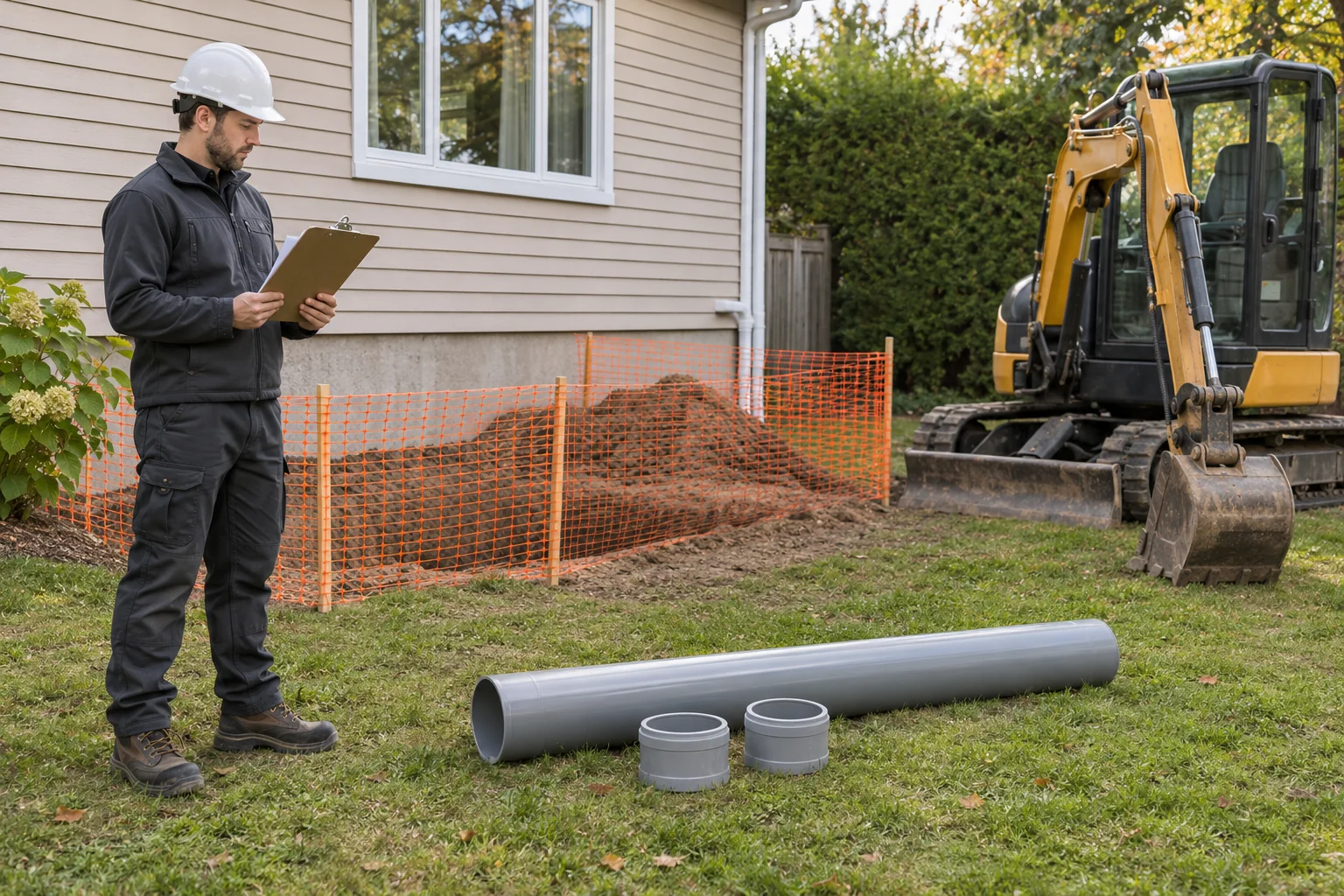
Before digging
Recurring blockages need a clear diagnosis
Several slow fixtures, a toilet reacting when another fixture drains, or repeated backups can point to the main drain. These symptoms do not prove that the pipe needs replacement. Accumulated material, a trapped object and a break can cause similar problems. The first goal is to identify the affected section and what is actually preventing wastewater from flowing.
A drain camera inspection can reveal roots, cracks, displaced connections or standing water in visible sections. Image quality depends on access and how clean the pipe is. If the camera cannot pass an obstruction, it cannot reliably describe everything beyond it. Clearing the obstruction or finding another access point may be necessary before the assessment can continue.
Ask where the defect is relative to the building and property, how its position will be confirmed and how much pipe appears affected. Video, locating information and observations should support one another. The age of a house alone does not justify sewer excavation or replacement of the entire connection. A useful recommendation explains the evidence and what remains uncertain.
An active emergency?
Limit wastewater before planning the permanent repair
If sewage is backing up, reduce the use of toilets, sinks, showers and appliances feeding the affected line. Keep occupants away from contaminated areas and mention the active backup when you call. Do not remove a cleanout cap when accumulated wastewater could escape behind it.
Stay away from water near electrical equipment. Never enter an excavation or try to expose a buried pipe yourself. Immediate safety and assessment come before choosing permanent work. Describe the location of the water and whether the level is still rising so the request reflects the actual situation.
Clearing and repairing have different goals
Our sewer backup service addresses the active situation and its assessment. Drain cleaning removes an obstruction. Main drain repair corrects a damaged section when the diagnosis supports that work.
Temporarily restored flow does not mean a crack has been repaired. Equally, a cleared blockage with no observed structural defect does not automatically require excavation. Ask which problem the proposed intervention is intended to solve.
A justified scope
Repair one section or replace a longer length?
The choice depends on the defect, its extent, the slope, the material and the condition of neighbouring sections. Ask what will remain, what will be replaced and what the proposal does not cover.
A localized defect
A clearly located displaced joint or broken section may support a targeted repair. Connections to the retained pipe must still be feasible. A small visible defect does not guarantee a simple job when the pipe is deep, access is restricted or structures sit above the work area.
More extensive deterioration
Several breaks, substantial deformation or problems along a longer section may call for a broader scope. Ask which observations support that choice. Full replacement should come with an explanation of why a limited repair would not adequately address the observed condition.
Tree roots in a sewer line
Removing roots may restore a passage without closing their entry point. Hydro jetting may be considered depending on pipe condition, but it does not repair an open joint. A longer-term decision depends on the observed defect and the options that can actually be provided.
A trenchless method is not automatically suitable for every property. Do not assume lining or another technique is available for your project. Ask which methods can genuinely be offered, their conditions and what would remain in place. This service request concerns assessment of the repair and any excavation required; suitability and scope must be confirmed for the specific line.
The right authority
Check the private and public sewer boundary
An obstruction beneath a driveway, near a sidewalk or towards the street does not by itself establish responsibility. The connection, applicable boundary and municipal procedure must be checked for the building address. Keep available reports and ask what documentation is needed before authorizing work that might affect a public portion.
Montréal’s official plumbing and sewer requests and authorizations page, in French distinguishes repair of the public portion from permit procedures for connection work. It directs readers to select their borough for the applicable process. Check the procedure for your circumstances rather than applying instructions from another district.
In the West Island, Laval and served municipalities on both shores, confirm requirements with the local authority as well. Establish who will contact it, who submits any application and which authorizations must be obtained before work starts. A private estimate does not replace municipal authorization or guarantee its processing time. Keep municipal communications with the repair documents so everyone works from the same information.
From diagnosis to restoration
How to prepare for sewer excavation
-
Define the work in writing
The proposal should identify the section, reason for repair, required access and planned checks. Ask whether diagnosis, locating and repair are included or priced separately. A clear description helps compare proposals covering the same intervention rather than comparing totals with different assumptions or exclusions.
-
Plan access and buried services
Identify known installations, landscaping, fences, steps and narrow passages. Confirm arrangements for locating buried services and preparing the site before digging. Do not move equipment or markers yourself to make room for machinery. Discuss how people will safely reach the building while the work area is restricted.
-
Organize building use
Drain use may need to stop temporarily. Ask which uses must pause, the estimated duration and whom to contact if the schedule changes. In a shared building, the owner or manager should coordinate affected occupants and provide authorized access. Make sure the person approving additional work can be reached during the intervention.
-
Repair, check and close
The work must reflect the accessible section and conditions discovered. Ask how connections and flow will be checked before backfilling. Distinguish closing the excavation from finishing the surfaces: lawn, pavers and asphalt may involve separate items or contractors. Confirm what condition the site will be left in and any later finishing steps.
Understand your estimate
What affects the cost of sewer line repair?
Depth, length, material and access affect the resources needed. A connection beneath an open lawn differs from a line beneath a slab or paved driveway. Handling excavated material, soil conditions, obstacles, authorizations and restoration can change the scope and timing. The visible repair length is only one part of the work required to reach and close the site.
Ask for a clear breakdown of diagnosis, excavation, piping, backfill and finishing. Clarify exclusions, taxes and how unexpected work will be authorized. No single price accurately represents every sewer line repair. A useful offer reflects your property conditions and states which assumptions still need confirmation.
If an unknown section proves damaged after opening the ground, ask for an explanation of the finding and its consequences before expanding the scope. Clarify who handles communications and return-to-service steps. The proposed schedule must allow for authorizations and actual site conditions rather than treating every excavation as identical.
Prepare for the call
Provide the address, building type and affected fixtures. Note backup dates, previous interventions and any link to rainfall. Gather available videos, reports and invoices. A photograph of a visible access point can help prepare the visit, but cannot establish the condition of the buried pipe.
After the work
Keep the work description and documents provided. Ask which sections were repaired and what signs should prompt another call. Follow instructions for resuming use and protecting restored surfaces. Follow-up based on actual findings is more useful than applying the same maintenance interval to every building.
Two questions before authorizing work
Does the repair have to happen immediately?
A collapsed line and a line that still drains create different constraints. Ask what makes the work urgent, which uses remain possible and what symptoms require another call. Any delay should reflect the findings. Do not assume another cleaning will always buy more time or that a temporary improvement removes the underlying defect.
Who decides in a condominium?
Notify the syndicate or manager if a shared section may be involved. Clarify approval and access to units before the appointment. Property boundaries and building documents can help organize the file. A problem appearing inside your unit does not, on its own, determine responsibility for the entire repair.
Make an informed decision
Tell us what is happening with your sewer line
Call Plomberie LaSalle at 514 312-3198 to discuss main drain repair or sewer excavation. Mention an active backup immediately. We will confirm availability at your address within the served territory and the information needed to prepare the assessment.
Explore our plumbing services and the Plomberie LaSalle homepage. A water supply line and a sewer serve different purposes: explain whether the problem concerns incoming water or wastewater leaving the building so the right intervention can be prepared.
Customer reviews