
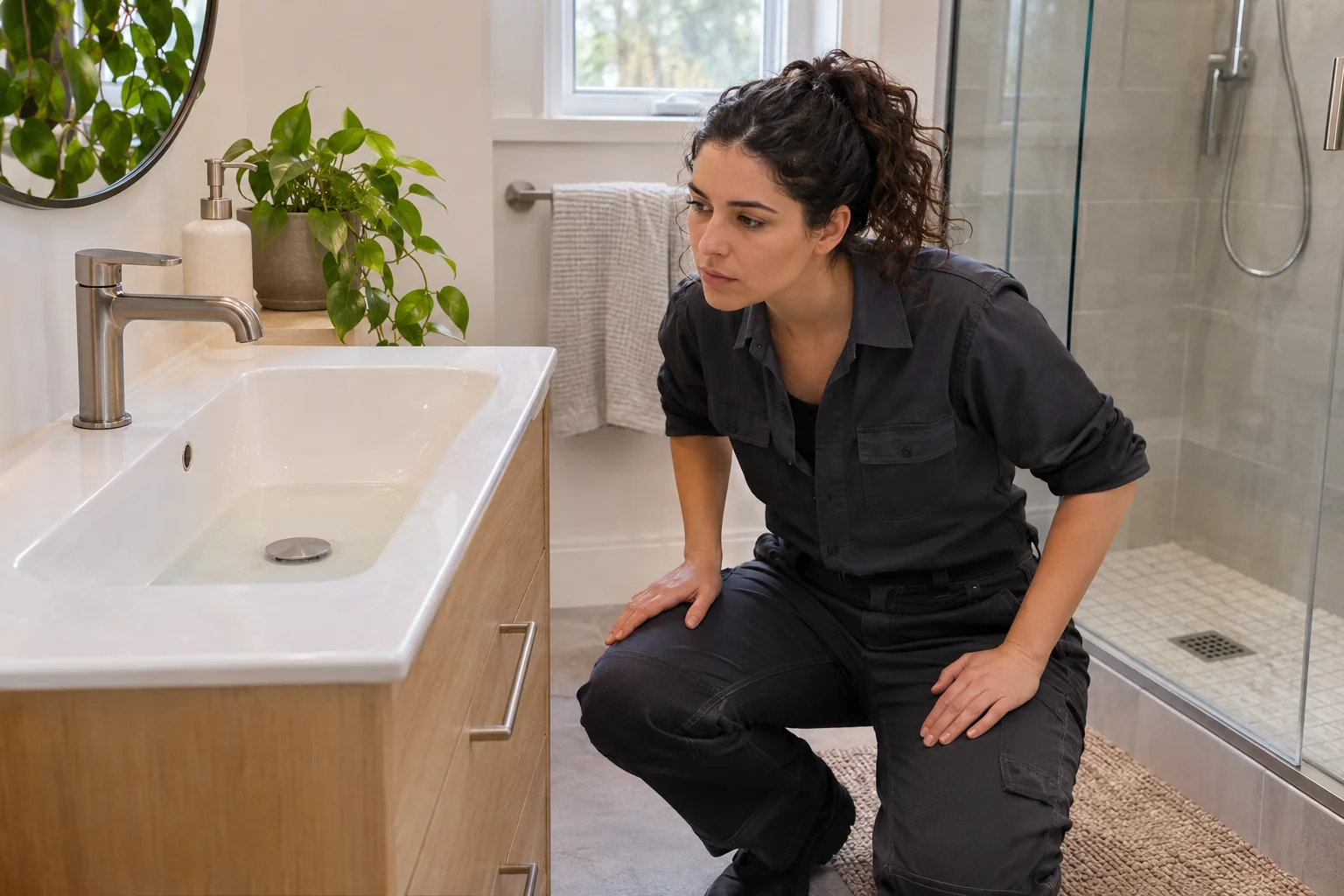
Is one fixture draining slowly, or are multiple drains backing up at the same time? Before deciding what caused it, note which fixtures are affected, where water appears and what was happening just beforehand. A single bathroom sink, both bowls of a kitchen sink and a shower receiving water after a toilet flush describe different situations. Those observations help a plumber prepare an assessment. They do not locate a blockage with certainty.
This guide offers a practical way to explain the problem without conducting more risky tests. It applies to a LaSalle house as well as a duplex, condominium or small business in Greater Montréal. You do not need to know the route of every pipe before asking for help. “I don’t know” is useful information when a cleanout is hidden, another unit is locked or a flooded room cannot be entered safely.
Key points
- Count fixtures carefully. Two bowls of one kitchen sink can share a drain; they do not establish two independent blockages.
- Describe the movement. Water draining slowly, rising in a bowl or coming out somewhere else provides different information.
- Stop repeating the test. Another flush or laundry cycle can add water to a drainage system that is already struggling.
- Prepare the facts. Times, rooms, products used and earlier work are more helpful than an unverified diagnosis.
1. One blocked drain or several: why the distinction matters
Water leaving a fixture normally travels through a branch before joining pipes used by other fixtures. A restriction can therefore have a local effect or interfere with several points. However, counting affected fixtures does not tell you how far away the blockage is. It also does not establish who owns the pipe responsible for the problem. The actual arrangement needs to be checked.
A bathroom sink that alone holds water may direct the first checks towards its own drainage. By comparison, a toilet, bathtub and floor drain reacting together make a shared section worth assessing. These are starting points. Two separate local problems can coexist, and one fixture that still works does not prove that the entire main drain is clear.
A useful comparison, without another test
Use observations from normal use that has already happened. The City of Toronto also distinguishes a single fixture from a sewer-service problem in its resident guidance. That distinction helps organize symptoms; Toronto’s municipal response procedure does not apply in Montréal. Explain the conditions in your building rather than borrowing another city’s instructions.
| Observation | Useful information | What it does not establish |
|---|---|---|
| One sink holds water | Room, when it began, what is known about other fixtures | That the trap must be the only problem |
| Both kitchen sink bowls rise | One double-bowl sink; any known dishwasher connection | Two independent blockages |
| Shower water rises after a flush | Fixture used and location where water appeared | A broken pipe or municipal responsibility |
| A floor drain overflows | Whether water is rising, other affected fixtures, safe access | The exact contents of the water or the defect’s location |
2. When only one fixture appears affected
A bathroom sink or shower that empties slowly
Explain whether the slowdown developed gradually or began suddenly. Mention a sink stopper that stays closed, debris visibly covering a strainer or water remaining well after use stops. These details separate what can be seen at the fixture from what remains hidden in the pipework. You do not need to identify the material causing a clog.
A photo of a strainer taken from a dry floor can help. Removing a drain fitting, dismantling a trap or inserting an object to investigate is unnecessary for preparing a call. Instead, mention anything already taken apart, fragile connections or a leak under the cabinet. A useful photograph shows the surroundings and available access as well as the standing water.
A toilet that will not drain
If the bowl rises after a flush, stop flushing. Mention a dropped object if you know about one, without reaching blindly into the toilet. Also distinguish a drainage blockage from a tank that will not refill or a weak flush. Those descriptions may lead to different checks and different repair work.
If the tank keeps feeding a bowl that threatens to overflow, a familiar, safely accessible local shutoff may stop that incoming water. Do not force a valve that resists. Closing it does not clear the drain or prevent water from elsewhere from returning. Report water leaking around the toilet base separately, because that symptom may require an additional assessment.
A double-bowl kitchen sink
Both bowls often connect to a shared drain. Describe “one kitchen sink with two bowls” rather than “two drains in different rooms.” If water has already moved between the bowls, say so. Do not run the dishwasher to check its connection: its discharge could add water to a restricted drain. Other fixtures that have not been observed can simply remain listed as unknown.
Tell the plumber if the cabinet below the sink is accessible and whether anything is leaking there. Do not empty standing water into another fixture whose drainage is uncertain. The aim is to communicate what has happened and keep the situation stable, without turning a contained blockage into a second wet area.
3. Multiple drains backing up: describe the connections you observed
The sequence often matters more than the count. “The basement shower rose while the washing machine was draining” identifies a specific relationship. “Everything is blocked” leaves several questions unanswered. Note the use already observed, where water emerged and the floor involved. Then stop that use instead of replaying the event for a clearer demonstration.
Identify low fixtures precisely. Water may appear at a basement shower or floor drain while someone uses plumbing upstairs. That makes a restriction in a shared section possible. A plumber still needs to examine the system before attributing everything to a blocked main drain. The location where water escapes is not automatically the location that needs repair.
Gurgling, odours and a level that falls again
Gurgling can accompany drainage or venting problems. The sound does not prove that a vent stack is blocked, and it is not a reason to climb onto the roof. Describe where you heard it and any connection with water use that you already noticed. A short recording made without exposure to water or other hazards can preserve the information.
A sewer odour does not reliably choose between a trap issue, venting and a blockage either. Explain whether it is new, limited to one room or accompanied by visible rising water. Do not lean over a cleanout to smell inside it. Likewise, a falling water level does not confirm that normal drainage has returned. A remaining restriction may cause another overflow when more water arrives.
When wastewater is already entering the room, describe an active backup at the start of your call. Our sewer-backup service page explains that intervention. For a blocked fixture without an overflow, the drain cleaning and unclogging service describes the corresponding work. The assessment determines the appropriate approach; you do not have to select equipment before calling.
4. What makes the call urgent?
Report water that keeps rising, wastewater in an occupied space, the only toilet becoming unusable or several units being affected. These facts help establish priority and organize access. They do not guarantee a particular arrival time. Give your full address and a callback number before searching for old paperwork, especially if conditions are changing.
If a sewer backup is possible, stop uses that discharge into the affected system, including toilets, showers, laundry and dishwashing. Alert other occupants. The City of Toronto warns that water sent down a drain may return to the basement. This precaution concerns water use. It does not establish that the municipal sewer caused the event or that another city will respond in the same way.
Keep a safe distance
Keep children and pets away from contaminated areas. Do not enter water to move electrical equipment. Under Hydro-Québec’s water-damage guidance, if power cannot be shut off safely from a dry location, move away and request remote disconnection at 1 800 790-2424. If you cannot leave without touching water or energized equipment, call 911.
A rotten-egg smell or hissing during sewer work can indicate a gas hazard. Leave without operating switches or using a telephone inside, then call 911 from a safe location. A threat to people takes priority over photographs or a plumbing appointment. Tell the plumber about an unsafe area so access can be assessed before anyone attempts to work there.
5. Avoid adding hazards before the visit
Do not add a drain opener to “prepare” the job. The CMMTQ advises against corrosive drain-opening products, in French. Report any product already used even when it made no difference. Keep the closed original container and its label available. There is no need to transfer a sample into another container for the plumber.
Health Canada advises never mixing household chemical products. Do not add bleach, another cleaner or a homemade mixture to a product already present. If chemicals remain in standing water, avoid plunging or dismantling that could splash it. For a concerning exposure, contact a poison centre or healthcare professional promptly and have the label information ready.
A visible cleanout should remain closed
A cleanout cap in the basement is not a shutoff valve. Removing it from a full line can release the contents. Identify its location only from a safe place. Do not plug an overflowing floor drain with a rag, cement or an improvised device. Blocking an escape point can move the overflow elsewhere without removing the cause.
For an exterior sewer blockage, do not rent a powered tool based on symptoms alone. Énergir explains the risk of a natural gas line crossing a sewer. Before clearing the affected line mechanically or with high-pressure water, contact Info-Excavation at 1 800 663-9228, option 1, for the required checks. Ask the contractor how this safety procedure applies to the work proposed at your property.
6. Prepare a description the plumber can use
A phone note or sheet of paper is enough. Record the information already available without returning to a dangerous room. An incomplete account provided promptly is more valuable than a detailed inventory that delays a call while water rises. Separate direct observations from explanations offered by a neighbour or a previous contractor.
- Where? Address, unit, floor and room. Identify a floor drain, shower, toilet or sink specifically.
- When? First appearance, gradual slowdown or sudden change, and any comparable previous event.
- What movement? Standing water, a rise during another use, an active overflow or a level that has already fallen.
- What connection? Fixture being used immediately beforehand, reactions elsewhere and reports from other occupants.
- What attempts? Plunger, dismantling, cable or chemical product, with its name, approximate amount and time used.
- What access? Route to the room, known cleanout, locked door and person able to authorize the work.
An example phone call
“I’m in a duplex in LaSalle. Around 8 p.m., water started rising in the basement shower while the washing machine was emptying. The nearby toilet was gurgling. We stopped the washer and notified the upstairs occupants. The water is no longer rising, but it remains in the shower. We have not added any chemicals. There is an outside entrance to the basement, and the owner is available to approve the work.”
This account describes a sequence without claiming to know where the blockage sits. Add uncertainty when needed: “I don’t know whether the floor drain reacted; I haven’t gone near it.” The plumber can then choose follow-up questions without confusing an unobserved fixture with a fixture known to be working.
If you share a video, say when it was recorded and whether the situation has changed since. A clip from yesterday may help explain a recurring noise, but it should not suggest that yesterday’s water level is the current one. Give the latest conditions verbally and retain earlier files as a dated history.
7. Coordinate a duplex, condominium or business
Notify the owner, property manager or condominium representative according to the building’s arrangements. One resident can stop a shower while an upstairs washer continues draining. Coordination therefore helps limit additional discharge. Ask the responsible person which uses should stop; do not operate an unfamiliar building shutoff to take control of a shared system yourself.
Attribute information reported by others: “The second-floor neighbour reports gurgling” is more accurate than “Every pipe is blocked.” Identify who will unlock common spaces and who can approve the work. They may be different people. If neither can be reached, explain that during the initial call rather than waiting for the plumber to arrive.
Make access practical without spreading damage
From a dry area, move only small, easily handled items. Do not cross sewage to remove furniture or lift a heavy appliance in search of a cleanout. Mention narrow stairs, parking constraints, a locked equipment room or an occupied business. These details help the contractor explain what access must be arranged and what cannot yet be reached.
If materials were wetted, restoring drainage and restoring the room are separate tasks. Québec’s cleanup guidance calls for hazard checks before entry and prompt cleaning and drying, generally within 24 to 48 hours. Arrange cleanup appropriate to contamination and materials. Clearing a pipe does not clean a floor, dry a wall or make damaged electrical equipment ready to use.
8. Useful questions during the assessment
Start with the question that matters: which fixture or section is preventing normal use? Ask where work will begin and why that access is suitable. You do not need to select cable diameter or water pressure. You can ask what the proposed method aims to remove and which questions it will leave unresolved.
Clarify the included steps, applicable travel or assessment charges, and approval required before additional work. Removing a toilet, reaching a hidden cleanout and examining a line are different scopes. A proposal should distinguish immediate clearing from a possible repair. A blockage alone does not make complete pipe replacement the inevitable next step.
If a camera is recommended
A drain camera inspection may provide useful images, particularly when symptoms recur. Ask which section can be viewed, whether cleaning is needed first and whether you will receive a recording or written report. Cloudy water, an obstruction or limited access can prevent a complete examination. “Not visible” does not mean “confirmed undamaged.”
Before commissioning municipal documentation, check the requirements for your address. For example, Dollard-des-Ormeaux requests a video and written report when a reported issue concerns the public side. This illustrates why the intended documents should be discussed beforehand. It is not a uniform rule for every municipality or a reimbursement guarantee. Responsibility questions require their own documented review beyond counting affected fixtures.
9. Keep a useful record after the drain is cleared
Ask which fixtures were checked and whether normal use can resume. Request any remaining restrictions and the signs that should prompt another call. Restored flow shows drainage under the conditions tested; it does not certify every concealed section. If access must remain available for another visit, record exactly which access point is needed.
Keep the invoice, recommendations, supplied images and intervention date together. If symptoms return, note the interval and affected fixtures. “The same shower, six days after clearing” allows a more useful comparison than “blocked again.” Recurrence warrants reconsidering the cause. It does not, by itself, prove roots, a sagging pipe or a structural break.
Helpful habits have limits
The City of Montréal warns against flushing wipes, hair and cooking grease. Keep food scraps and grease out of kitchen drains as well. Clean accessible strainers without pushing debris into the pipe. These habits reduce unwanted material entering the system, but they do not repair a pipe defect or guarantee that a backup will never happen again.
To arrange a visit, call Plomberie LaSalle at 514 312-3198 and confirm availability for your address. The Contact page suits planned requests; explain actively rising water by telephone. You can also browse our plumbing tips and the Blocked drains and toilets category for related guidance.
Frequently asked questions
Do two blocked drains mean the main drain is blocked?
No. Two fixtures may share a local branch, while two bowls may belong to one kitchen sink. Describe the rooms, floors and reactions already observed. The plumber needs to check the layout and access before locating an obstruction. Fixture count alone does not establish a repair plan.
Can we use an upstairs toilet while the basement backs up?
Do not assume its drainage is independent. Stop uses that could feed the affected system and request building-specific instructions. In a shared property, notify the responsible person and other occupants. Do not perform another flush simply to find out whether water returns downstairs.
Will closing the main water valve stop several drains backing up?
Closing a known interior supply valve may prevent some household discharge, but it does not stop water already in a drain or a backup entering from outside. Stop use and protect people first. Do not reach a valve through contaminated water or an electrically hazardous area.
Is the problem solved if the water eventually goes down?
Not necessarily. A restriction can allow slow drainage while remaining troublesome during the next use. Record the approximate timing and change already observed. If it recurs, affects several fixtures or involves rising water, seek an assessment instead of repeatedly testing the line.
Sources and practical references
These references support the safety precautions and general distinctions used here. The observation and call examples help prepare an assessment; they do not replace examination of the installation.
- Hydro-Québec — Water damage and electrical safety
- Énergir — Blocked sewer lines and cross bores
- Health Canada — Household chemical safety
- CMMTQ — Warning about corrosive drain openers, in French
- Toronto — Single fixture or blocked drainage
- Toronto — Precautions during a sewer backup
- Québec — Cleaning up after a disaster
- Dollard-des-Ormeaux — Documenting sewer backflow
- Montréal — What not to throw in the toilet