
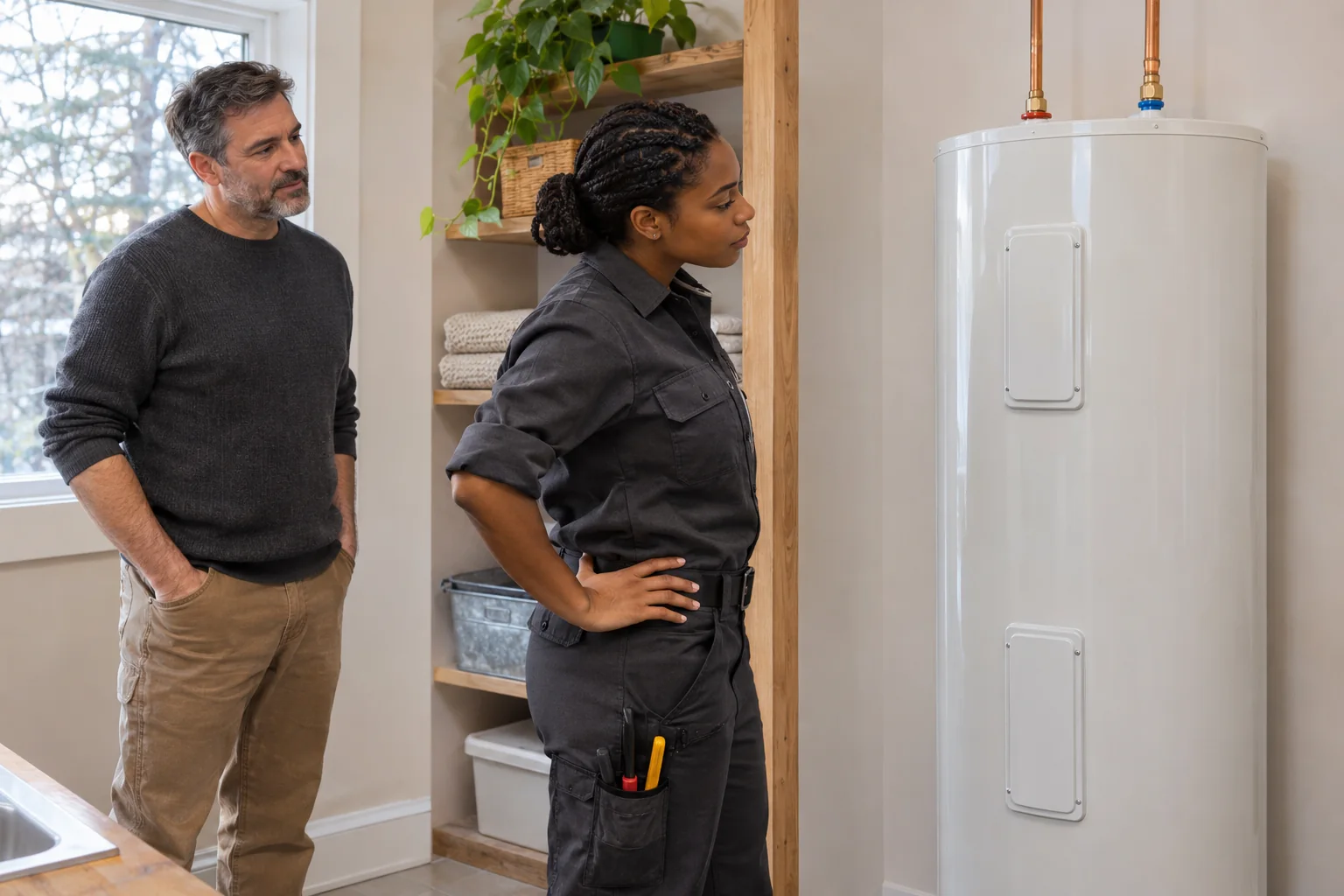
Should you repair or replace a water heater that leaks, stops heating or needs another service call? Start with the actual fault. Then compare the tank’s condition, the work each option includes, available warranty coverage and the limits of your installation. Age helps frame the questions, but it cannot provide a diagnosis by itself.
This guide helps you prepare that decision for an electric storage water heater in LaSalle or elsewhere in Québec. It includes a comparison table, questions for the assessment and a practical record to keep. Gas appliances, shared building systems and heat-pump water heaters also need checks specific to their technology. A photograph cannot establish that a tank is safe or that one particular repair will solve the problem.
Key points
- Observe without opening. Water beneath the heater does not prove that the inner tank leaks.
- Compare complete scopes. A new component does not make the whole tank new.
- Check your documents. Warranty, rental and insurance conditions can affect the options.
- Put safety first. Water near electrical equipment or unexpectedly scalding water needs prompt attention.
1. Identify urgent conditions before comparing options
A loss of comfort and a spreading leak need different responses. Report rising water, continuous leakage, signs of overheating or a burning smell immediately. If there is smoke, sparking or immediate danger, move away and call emergency services. Finding an old invoice must never delay getting people out of a hazardous area.
Hydro-Québec’s water-damage guidance explains when a power shutdown is unsafe. Do not walk through water to reach the electrical panel. Avoid wet electrical equipment and wiring. If you cannot safely isolate the supply, leave the hazardous area and get help. Electrical installations affected by water need a master electrician’s assessment before power is restored.
A clearly identified control may allow the appliance to be isolated from a dry, safe location, following appropriate instructions. However, do not force a valve or improvise a building-wide shutdown. Never cap the temperature-and-pressure relief valve or its discharge pipe to stop water escaping. Leave the heater’s access covers closed and avoid repeated breaker resets.
Our guide to safe first steps during a water leak provides related precautions. Tell the plumber if the water appears to come from nearby piping. The work may involve repairing a plumbing leak rather than replacing the tank. The source needs to be established before you make the final purchasing decision.
2. Describe the symptoms without choosing a part
Begin with what happened during normal use. Is the water cold everywhere, or only at one shower? Did the change happen suddenly or develop gradually? Does the supply become lukewarm after several closely spaced uses? One affected fixture and a problem throughout the home lead to different checks. You do not need to run more water to demonstrate a fault that is already apparent.
The Giant residential electric water-heater manual lists several possible causes of insufficient hot water, including the power supply, failed components and high demand. This is why cold water does not automatically mean the tank has reached the end of its life. Use the manual for your actual model; electrical testing belongs with a qualified professional.
For a leak, describe the first visible wet area you can see from dry ground. It may be near an upper connection, the relief discharge pipe, the drain valve or the outer casing. Water can travel before forming a puddle. Do not pull away insulation or move the tank. If the source is hidden, record it as unknown until the assessment.
Report unusual noises, odours and discolouration separately. Mention whether you have also noticed discolouration in cold water, without creating another test. These observations alone do not prove internal corrosion. Do not add chemicals to the tank to treat an odour before someone has assessed the cause and the appropriate response.
3. Repair or replace a water heater: a decision table
A useful assessment separates three questions: what fault has been confirmed, what each option would correct and what would remain uncertain. Ask for a plain explanation. “Replace this connection to stop the identified leak” is more helpful than “change everything for peace of mind.” A recommendation should connect the proposed work to something the professional actually found.
| Confirmed finding | Option to examine | Question before approval |
|---|---|---|
| A fault limited to a replaceable component | A targeted repair, if the overall condition supports it | What result and workmanship coverage are included? |
| Leakage from the inner tank itself | Replacing the appliance | Does tank coverage apply, and which costs remain? |
| Recurring trouble or several faults | A complete repair-versus-replacement comparison | Has a shared underlying cause been investigated? |
| Changed household needs | Assessing storage capacity and recovery | Is this a failure or a mismatch with the usage pattern? |
| An insurance contract requirement | Planning with the insurer | What deadline and proof does this policy require? |
The table organizes a conversation; it does not test the heater. A technically possible repair may offer poor value in a particular situation. Conversely, one recent fault does not automatically justify replacing an otherwise satisfactory unit. The recommendation needs to fit the evidence and the installation, rather than a rule based only on age or one visible symptom.
4. When a repair deserves consideration
A repair is easier to evaluate when the fault is specific, a compatible part is available and the overall condition has been assessed. Ask whether the estimate includes diagnosis, the part, labour and checks afterwards. Also identify any electrical work and who will perform it. An estimate based only on a telephone description may change once the unit can be examined.
Ask an essential question: “Does this address the cause, or only a consequence?” For example, discharge from the relief valve calls for understanding why it is releasing water. Changing a part without checking system conditions could leave the problem unresolved. Discharge does not necessarily mean that the valve itself has failed.
Next, ask what the professional can establish about the tank and what remains out of sight. Replacing a component does not reset the tank’s age or renew every warranty. No one can responsibly promise a fixed number of extra years from that repair alone. Keep this distinction in the comparison even if the hot water returns quickly.
Our electric water-heater service page explains the service itself. For your decision, keep the written scope and expected result at hand. You should understand the work you are buying without having to select a heating element or interpret electrical measurements yourself.
5. When replacement becomes more reasonable
Confirmed leakage from the inner tank changes the decision. The next step is to plan replacement and check the warranty documents, rather than rely on an external patch. Repairing a nearby connection will not solve a leaking tank wall. However, the assessment must distinguish the tank from surrounding components before condemning the appliance.
Replacement also deserves a comparison when several repairs have accumulated or suitable parts are difficult to obtain. Gather previous invoices. The same symptom, the same component and the same cause are different things. A problem returning shortly after work may call for follow-up on that work before a new purchase. Ask what additional finding supports a different conclusion.
Consider the practical effects of another interruption. An occupied rental, a large household and a home left empty for extended periods have different needs. This does not turn an unknown risk into a certainty that the tank will fail. It helps determine whether a temporary approach is suitable or a planned replacement would avoid practical difficulties.
Finally, distinguish a necessary replacement from a desired upgrade. You may want a different capacity, easier access or a new technology. Those are valid goals, but the proposal should identify them clearly. That way, you can compare the option that corrects today’s fault with features intended to meet future needs.
6. Age, warranty and insurance answer different questions
Manufacturing date and installation date
Photograph an accessible rating plate and look for the installation invoice. The manufacturing date is not always the date the tank entered service. If you cannot interpret a serial-number code, ask the manufacturer to confirm it. Do not assign a year because another heater looks similar. An unknown date should remain unknown until there is reliable evidence.
Manufacturer coverage and consumer rights
Check the tank, parts, labour, transportation and removal separately. Coverage for a replacement tank does not mean the entire visit is free. Ask about the claim procedure before a component or appliance is discarded, while keeping safety the priority. Save photographs, receipts and the claim reference. Confirm who needs to examine the failed equipment and who will arrange that step.
The Office de la protection du consommateur explains Québec’s legal warranties, including reasonable service life for goods purchased from a merchant. These are separate from commercial warranties and depend on factors such as price, contract and use. An expired written warranty does not automatically eliminate all rights. It also does not guarantee that a particular claim will be accepted.
Your insurer’s conditions
Ask your insurer about the conditions applying to your tank: the age it uses, any deadline, possible exclusions and the records it needs. An insurance condition is not a Québec law requiring every household to replace every heater at the same age. Obtain an answer tied to your own policy. Replacing a component does not necessarily change the date the insurer uses for the tank.
7. Temperature: address both scalding and Legionella
Unexpectedly scalding water needs prompt assessment. Do not try to compensate for a shortage by raising an internal setting. The INSPQ recommends setting water-heater temperature at 60°C to limit Legionella growth. That public-health recommendation does not mean water should reach your skin at the same temperature. The linked Québec public-health page is in French.
Storage temperature and protection at a bathing fixture are separate matters. The INSPQ’s domestic hot-water scalding guidance describes limits of 49°C at bath and shower outlets generally, and 43°C for the care facilities and private seniors’ residences covered by the specific rules. Water at 49°C can still burn; it is not harmless during prolonged exposure.
Have the professional check the settings and suitable protective devices. Children and people with limitations need particular care. Arbitrarily lowering the tank temperature or adding an improvised device is not a complete solution. If only one shower has the problem, explain that clearly so the fixture can also be considered during the assessment.
8. Compare costs on the same basis
To decide whether to repair or replace a water heater, request comparable scopes when both options are realistic. For a repair, identify the fault covered, call-out or assessment charges, parts, checks and exclusions. For replacement, include the appliance, handling, removal, connections, adaptations and taxes. The advertised price of the tank alone cannot describe the whole installation.
Check shared costs as well. If an adaptation is needed under either option, it should not appear as an exclusive advantage of replacement. Conversely, work needed only for the new unit deserves a separate line. This makes the proposals easier to understand without applying a universal percentage of the purchase price as a repair limit.
Ask two further questions: how long would each option leave you without hot water, and what happens if a discovery changes the price? Confirm part availability and how extra work will be authorized. Do not treat a preliminary estimate as a firm total when the fault or access still needs checking.
You may authorize immediate work to make the situation safe while reserving the final purchasing decision. Have the first intervention separated from a possible replacement. Ask which amounts would carry forward, be added or remain separate at the next stage. This avoids making a rushed choice based on only part of the expected bill.
9. Plan replacement without copying an old installation
Capacity depends on more than the number of residents. Describe back-to-back showers, a large bathtub, overlapping uses and changes you expect in the household. Ask what storage and recovery performance would meet that pattern. Record capacity in litres or in the exact unit printed on the label. Gallons from different measurement systems are not interchangeable.
Photograph the route to the unit: doors, stairs, available height and the utility room. Do not move the tank to measure behind it. A larger model may need adaptations, while another technology may have different installation conditions. Natural Resources Canada’s residential water-heater guide explains options such as heat-pump units, which draw heat from surrounding air. Suitability needs to be considered for the room and climate.
Ask which checks are needed for the drain pan, relief discharge, service access and connections. The RBQ/CMMTQ sheet about replacement in existing buildings explains why these details matter. Dated 2019 and published in French, it is a technical reference to check against current requirements and manufacturer instructions. It does not establish compliance for your installation.
The RBQ identifies the current Québec Plumbing chapter, based on the 2020 National Plumbing Code with Québec amendments. Copying the old arrangement is not proof that a new installation meets the applicable requirements. Have the installer explain any corrections that belong in the proposed scope.
A pan can limit some damage without guaranteeing that no damage will occur. Leak detectors and automatic shutoff devices also need compatible installation and upkeep. Clarify what is included, who maintains each device and how occupants receive an alert. A broad promise of protection is less useful than those specific answers.
10. Permissions, rental tanks and shared buildings
Identify who owns the heater before ordering work. A rental unit may belong to a supplier whose contract governs service, removal and ending the rental. A tenant should notify the owner or manager and explain the urgency. In a condominium, check the syndicate’s procedure and any common portions affected. Do not authorize a shutdown affecting neighbours on your own.
Professional responsibilities depend on the work. The RBQ states that work on electrical installations requires a contractor holding the appropriate licence. Exceptions for some work done by property owners do not authorize improvised electrical connections. Ask who will handle each part and verify the qualifications corresponding to the actual scope.
In LaSalle, describe the project to the appropriate permit counter when authorization needs clarification, especially for relocation or renovation. The borough’s permit and certificate process, available in French, offers help checking whether a project requires authorization. It does not support claiming that all tank replacements are exempt or need the same permit. For another address, consult that municipality.
11. Prepare a useful call and keep a clear record
You do not need a perfect file before calling. Give the address, explain any active leakage and mention visible hazards first. Then gather only what you can access safely. A wider photograph may be more useful than a close-up without context. Avoid sharing an entire invoice when the model and installation date are all that is needed.
- Readable brand, model, serial number and storage capacity.
- Known manufacturing, purchase and installation dates, with supporting documents.
- Symptoms, when they began and previous service work.
- Photographs of the appliance, visible connections and access route.
- Rental status, warranty documents and any insurer’s request.
- The person providing access and the person authorizing work.
After the work, keep the completed scope, details of replaced components, any new appliance documents and the restart instructions. Ask when normal use can resume and what signs mean you should call again. If the problem returns, record how long it took and whether the symptoms match. This makes follow-up clearer than simply reporting that it has failed again.
For an assessment, call Plomberie LaSalle at 514 312-3198 and confirm availability for your address. The Contact page is suitable for planned requests. You can also browse our plumbing tips and the Water heaters and hot water category. The aim is an explained decision and a scope of work you understand.
Frequently asked questions
Must every water heater be replaced after ten years?
That birthday alone does not provide a technical verdict. Have the condition and fault assessed, then check your insurance and warranty terms. An insurer’s deadline can matter to your decision without becoming a single rule for every heater in Québec. Confirm which date and documentation your own insurer uses.
Does a puddle beneath the tank mean replacement?
The source needs to be confirmed. Water can come from a connection, a relief valve, nearby piping or the tank itself. Do not dismantle anything to find it. Report an active leak and keep clear if electrical equipment may be affected. Confirmed inner-tank leakage calls for planning replacement.
How do you repair or replace a water heater under warranty?
First establish which component or appliance is covered and which charges remain. Check the claim procedure before removal and retain the evidence. Then compare the expected outcomes of the options actually offered. Tank coverage does not automatically pay for all diagnostic work, handling and labour.
Should you drain the heater before the visit?
Wait for instructions suited to the appliance and installation. Draining involves hot water and can worsen a poorly controlled situation. Never restore power to an empty or partly empty tank. If the heater has been flooded, have it assessed before any attempt to return it to service.
Sources and further guidance
Sources consulted in November 2026. The examples and comparison table help prepare a decision; the diagnosis and applicable requirements need confirmation for the actual installation.
- Giant — Residential electric water-heater manual, safety and troubleshooting
- Hydro-Québec — Water damage and electrical safety
- INSPQ — Legionella and water-heater temperature, in French
- INSPQ — Domestic hot-water scalding, in French
- Office de la protection du consommateur — Warranties
- RBQ — Work you can do yourself and licensed work
- RBQ/CMMTQ — Replacement in existing buildings, PL-18, 2019, in French
- RBQ — Current Plumbing chapter of the Construction Code
- Montréal — LaSalle permit and certificate process, in French
- Natural Resources Canada — Guide to residential water heaters