
Knowing what to do with a water leak starts with a safe decision, not a repair. Look for hazards from a dry location, stop using the affected fixture and close a clearly identified indoor water valve only when you can reach and operate it safely. Then call for help and arrange drying. A puddle beneath a sink, water spreading across a basement and a bulging ceiling require different responses.
This guide helps you choose the next step in a LaSalle home, a Montréal duplex, a condo or a commercial building. You do not need to identify a failed fitting before asking for assistance. Explain where the water appears, whether it is still flowing and what you can safely see. An honest description of an uncertain source is more useful than an unverified diagnosis.
Key takeaways
- Protect people first. Keep occupants away from the affected area. Unsafe access may prevent you from reaching the water shutoff yourself.
- Stop the affected use. Operate a known indoor valve gently only when access is safe. Do not dismantle anything or force a resistant handle.
- Call with observations. Give the address, current flow, visible hazards and the result of any shutoff you have already completed.
- Plan two follow-ups. Repairing the plumbing and drying the affected building materials are separate tasks.
1. Water leak safety: check the area before acting
Pause at the doorway and look at the floor, outlets, extension cords and appliances. Do not walk through a wet area to reach an electrical panel or a water valve. Do not try to unplug wet equipment. Boots, a mat or a wooden handle do not make a potentially energized area safe to enter.
Hydro-Québec’s water-damage instructions permit operating the main breaker only when the floor around the panel, your hands, feet and shoes are completely dry, without simultaneously touching a metal object. If those conditions are absent, leave without touching the water. Call 1 800 790-2424 for a remote power shutdown. If you cannot leave without contacting water or energized equipment, call 911.
Also keep clear of a bulging ceiling, a distorted wall or falling material. Do not stand on a chair beneath a pocket of water to inspect it. Warn people on the floor below and keep children and pets out of the affected room. When someone faces immediate danger, the appropriate emergency services take priority over a plumbing appointment.
2. Choose an accessible indoor water shutoff
Once you have a safe route, stop using the fixture involved. A small supply valve may isolate a toilet or a sink. Use it only if you recognize it and understand its normal operation. A handle hidden behind a heavy machine or beside a hot pipe does not offer reasonable access during an unfolding incident.
If the source is unclear or a local valve does not control it, the indoor main shutoff may stop the water supply to the dwelling or building. Its location varies. Use labels or information previously supplied by the owner or manager rather than assuming every house has the same arrangement. CAA-Québec’s advice on water damage recommends stopping the water supply and contacting a plumber when a break occurs and it is safe to intervene.
If the valve resists or starts leaking
Stop manipulating it. Do not extend a lever with pliers or loosen a component to make it move. A handle that resists, turns without an effect or leaks around its stem is important information for the call. Say, “I cannot stop the water,” rather than describing the incident only as a small leak.
After a safe shutoff, observe whether the flow decreases from the dry area. Water already inside pipes or building materials can continue to escape. Therefore, do not reopen the valve repeatedly to test the result. Write down which valve you closed and the approximate time, so everyone helping has the same information.
3. Understand what a shutoff can change
Closing the supply can limit a pressurized drinking-water leak. It does not automatically stop rain entering through a roof, water coming through a foundation or a sewer backup. If water continues, describe that fact without deciding that the valve must have failed. A professional still needs to establish the source and the route the water has taken.
| What you observe | A useful first decision | What to report |
|---|---|---|
| A spray or repeated drops on a visible supply | Isolate the known supply if access is safe | The visible location and effect of closing the valve |
| Water after someone uses a sink | Stop that use without repeating the test | When it appeared and which fixture was in use |
| A wet or distorted ceiling | Keep the area clear and notify the occupants above | Rooms and units involved, including changes in shape |
| Water rising from a drain | Stop uses that add wastewater | Affected drains, odours and visible material |
Use this comparison to communicate, rather than to select a replacement part. Water returning through a drain may call for the sewer-backup service. For an indoor water supply that is leaking, the water-leak repair service explains how the source, access and repair options are assessed.
4. A leak under the sink: observe without dismantling
A sink cabinet can contain several supply and drain connections close together. Water may follow a hose before dripping onto the bottom of the cabinet. As a result, the first wet spot you notice may not be the failed component. A general photograph taken without touching the plumbing can help show the arrangement.
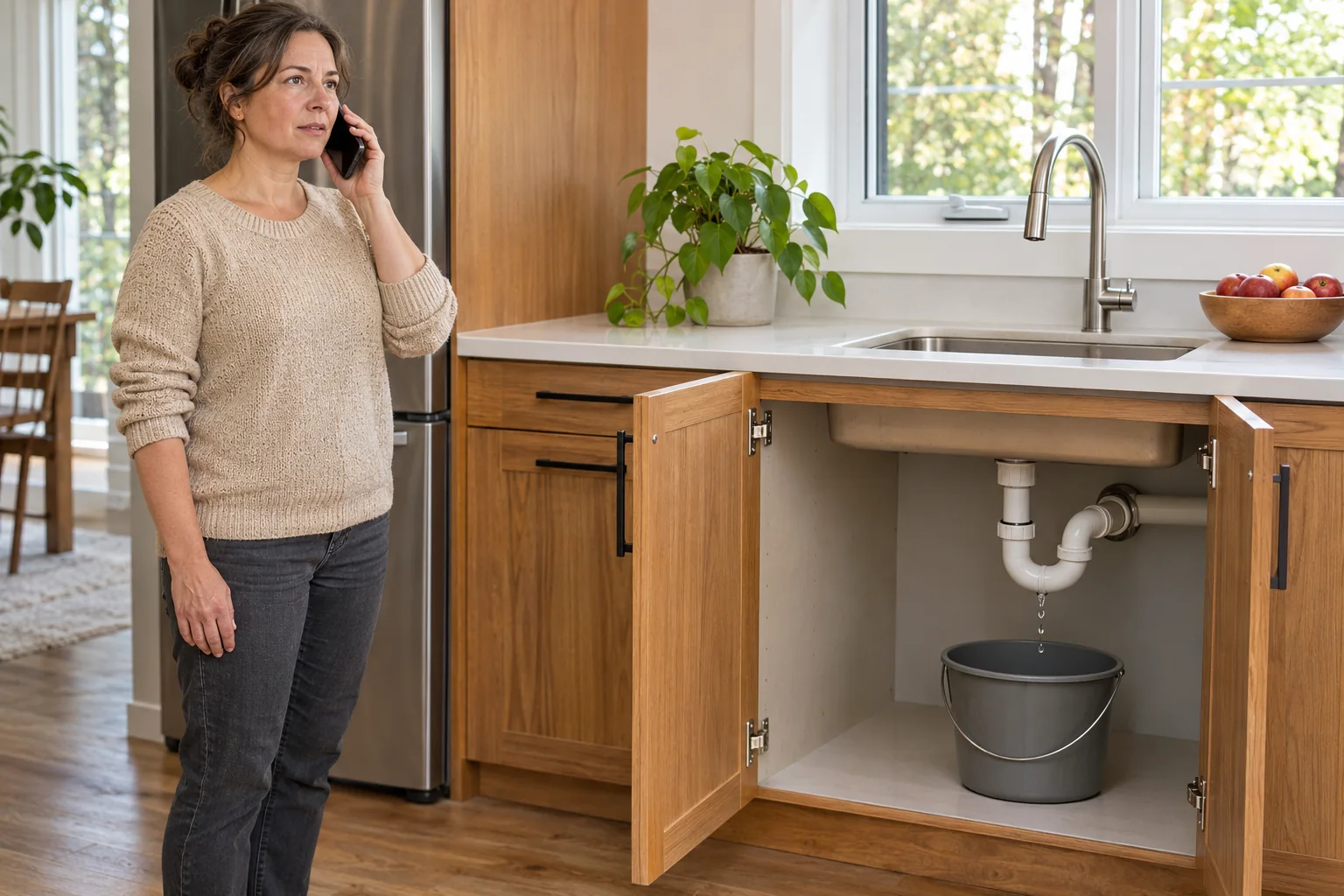
If the floor is dry and access is safe, move only lightweight belongings that obstruct the view or risk getting wet. Watch for spilled cleaning products, outlets and a connected waste disposer. A container may catch a small, safely accessible drip, but it does not replace controlling the supply. Do not put your head beneath an unstable or hazardous area to position it.
Think back to what happened before discovery. Was the tap running, had the sink just emptied, or was the dishwasher operating? Record what you already know. However, do not add more water to obtain a perfect demonstration. Your account of an intermittent leak remains useful even when you cannot reproduce it during the call.
Avoid tightening every visible nut. That can move a component, conceal an observation or create another problem without establishing the cause. A useful description is straightforward: “The cabinet floor is wet. I stopped using the tap and closed the labelled valve. Drops are still appearing.” Add the time and any change in the amount of water.
5. A ceiling water leak: protect the space below
A ceiling stain may appear some distance from the actual source. In a duplex, identify the room above and notify its occupants. In a condo, also reach the property manager or the syndicate’s emergency contact. Ask people to suspend use of a suspected fixture while the situation is assessed, without assigning responsibility before anyone has checked it.
Bulging, a new crack or sagging calls for distance. Do not puncture the ceiling to drain a pocket of water, and do not remove a light fitting. Those actions can expose you to falling materials and concealed installations. Tell the person receiving your call if the ceiling is changing shape, rather than reporting only a stain.
Where safe access remains available, move documents and small belongings to a dry room, away from the unstable area. Do not try to carry a heavy piece of furniture alone while the incident develops. Above all, preserve a clear exit and an access route for the people who will attend the building.
If an older mark appears stable, photograph it and arrange an assessment before repainting. Its colour or shape cannot reliably date the leak. A spreading edge, a new smell or a softening surface gives the professional more useful information. Record those changes without pressing, scraping or opening the affected material yourself.
6. What to do with a water leak: make a clear call
For an active leak, call rather than waiting for a contact-form reply. Plomberie LaSalle’s number is 514 312-3198. Give the full address at the start. Availability and arrival time need confirmation for your location, the building access and the circumstances you describe; they cannot be inferred from a general service-area label.
Prepare a short summary: “Water appeared in this room at about this time. It is still flowing, or it appears to have stopped. I closed this valve, with this result. There is, or may be, water near electrical equipment. The owner or manager can be reached at this number.” Mention immediately anything you could not safely access.
- Building type, floor and affected dwelling units.
- Current flow: a drip, continuous runoff or water spreading rapidly.
- Fixtures used before discovery and any recent work you know about.
- Doors, common areas or mechanical rooms that require access arrangements.
- The person who will be on site and a reliable callback number.
You do not need to measure the flow or identify the pipe material before calling. Similarly, do not delay while looking for an old invoice. Those details can follow. If someone has already contacted the municipality, an electrician or a restoration company, explain that coordination so the next steps do not conflict.
7. Rentals, condos and shared buildings: coordinate access
A general water shutoff in a shared building may affect several occupants. Notify the owner, caretaker or manager promptly. Explain whether you can access a unit valve or whether the mechanical room is locked. Do not force a door or manipulate an unknown common pipe in an attempt to save time.
For tenants, the Tribunal administratif du logement explains urgent and necessary repairs. Make every effort to contact the landlord or usual representative before incurring an urgent expense, keep records of those efforts and limit intervention to essential work. Read the full procedure for your circumstances. A plumbing call does not settle responsibility or determine what another party must reimburse.
In practice, keep a simple timeline: discovery, calls, messages, replies and any shutoff completed. One person can collect information while another notifies directly affected neighbours. This helps prevent different people from reopening valves or restarting equipment without realizing that someone else is trying to contain the leak.
For a commercial property, describe occupied areas, exposed stock and available entrances. Keep customers and staff away from a wet route. Also identify who can authorize access to restricted rooms. Maintaining operations comes after protecting people and controlling the water; an attendance plan needs to reflect the actual conditions inside the building.
8. A water-service leak may need municipal coordination
If the indoor main valve cannot be used, or the leak appears near the water service entrance, an exterior shutoff may be necessary. Plumbing work then needs coordination with the responsible authority. In Montréal, the official water-service shutoff procedure directs owners to their borough; 311 can route the request. Select LaSalle or the building’s borough to check the applicable details.
The exterior service box is different from the small valve under a sink. Do not try to operate it with an improvised tool. Instead, prepare the exact address and state clearly if water cannot be stopped indoors. Appointment arrangements, timing and charges can vary. Montréal’s procedure does not automatically apply to Laval or another municipality.
A problem near the main supply may require a water-service line assessment. Ask who will arrange the exterior closure, who needs to be present and how reopening will be coordinated. That distinction matters: a plumber’s availability and the municipality’s availability are separate parts of the response.
9. Document damage without delaying assistance
After safety and urgent calls are addressed, take a few photographs from a safe location. Begin with a view of the room, followed by the wet area and affected belongings. Keep the original files. A short video can show continuing flow, but obtaining it should not require moving closer to a hazard.
Separate observation from assumption. “Water discovered beneath the cabinet at 9 p.m.” records a fact. “A fitting has been defective for three weeks” is a conclusion unless someone established it. Include changes after the shutoff and contact details for attending professionals. Clear notes help everyone understand the sequence without guessing.
Infoassurance’s water-damage guidance recommends contacting the insurer promptly and keeping invoices for urgent work. Ask for instructions about damaged belongings, replaced parts and restoration work. Coverage depends on the policy and claim assessment. A suspected cause or the fact that plumbing repairs were necessary does not establish insurance coverage.
Nevertheless, documentation must fit around reasonable damage-control measures. Do not allow water to continue flowing for more photographs. Likewise, do not keep a contaminated object in an occupied room solely as evidence. Ask how to record it and arrange appropriate disposal, and retain the instructions and receipts with the rest of your file.
10. Arrange cleanup and drying after the leak
A successful repair may stop the incoming water while leaving a floor, wall or cabinet wet. Therefore, ask who will assess the affected materials and monitor drying. Wiping a surface does not establish the condition of a concealed cavity. Avoid closing or repainting an area before the remaining moisture has been evaluated.
The Québec government recommends cleaning and drying within 24 to 48 hours to limit mould development. Treat that as a reason to act promptly, rather than a waiting period. It does not guarantee that materials will remain unaffected until a deadline, or that everything will be dry after two days without assessment.
For a small amount of water from a known source in a safe area, simple containment and cleanup may limit damage while you obtain instructions. For an extensive area, hidden water, soaked materials or uncertain contamination, contact a restoration company. Describe the likely duration and affected materials, rather than judging the work solely by the size of the visible puddle.
Sewage changes the precautions. Health Canada’s flood-cleanup guidance explains contamination risks and the need for additional protection. Keep vulnerable people away and request advice appropriate to the water involved. Never use a combustion-powered pump or heater indoors when it is intended for outdoor use.
11. Plan a controlled return to use
Before the attending professional leaves, ask what they confirmed: the source, the component repaired, the checks completed and any limits of the work. Clarify whether the shutoff is temporary, whether a part still needs replacement and which fixtures or equipment must remain unused. Also record the callback procedure in case water reappears.
After water has affected electrical installations, do not restore power yourself; involve a master electrician in accordance with Hydro-Québec’s instructions. For flooded heating equipment, the RBQ provides checks and safety guidance before reuse. Equipment that looks dry on the outside is not automatically ready to operate.
Over the following days, observe accessible areas without reopening the installation. Report a new drop, an expanding stain or a persistent smell. Photographs taken from the same position can make changes easier to explain. If the problem returns after using a fixture, stop that use and report the circumstances rather than repeatedly recreating them.
Finally, once conditions are stable, have shutoffs identified and keep access clear. Discuss leak detectors and, where appropriate, an automatic water-shutoff system. These measures need to suit the building and receive maintenance. They do not replace correcting the defect or following up on wet materials, but they can form part of a more practical response plan.
Frequently asked questions
The leak stopped by itself. Can the assessment wait?
An apparent stop does not confirm the cause. Record the circumstances, stop the use that seemed connected and arrange an assessment. If materials remain wet or another unit is affected, continue the coordination and drying arrangements. Do not wait for water to return before following up on damage that already exists.
Should I drain a leaking water heater?
Do not begin an improvised draining procedure. Describe the water, apparent heat and any electrical hazards from a safe location. Isolation, taking the equipment out of service and repair depend on the installation. The electric water-heater service explains the information to prepare for an assessment of that equipment.
Should I open the wall before the plumber arrives?
Prepare existing access points, but leave exploratory openings to the professional who has assessed the source and concealed hazards. A photograph and a description of the changes are more helpful than a randomly placed opening. Then ask what restoration will be necessary and which part of that work is included.
Who should I call when the source is unknown?
Describe what you see rather than choosing a cause. A plumbing company can help establish whether a supply or drainage assessment is appropriate. Immediate hazards require the appropriate emergency response first. For plumbing assistance, call 514 312-3198 with the address and current condition of the flow. Say plainly when you cannot safely check something.
Sources and useful resources
The safety guidance was checked against the organizations below. Follow current instructions from authorities and professionals attending the property as conditions develop. Some supporting Québec resources are available in French.
- Hydro-Québec — Water damage or flooding.
- Ville de Montréal — Water-service shutoff and location.
- Québec — Cleaning up your house after a disaster.
- Health Canada — Flood cleanup and indoor air quality.
- TAL — Urgent and necessary repairs.
- Infoassurance — Water damage and claims (French).
- CAA-Québec — Preventing and responding to water damage (French).
- RBQ — Guidance following flooding (French).