
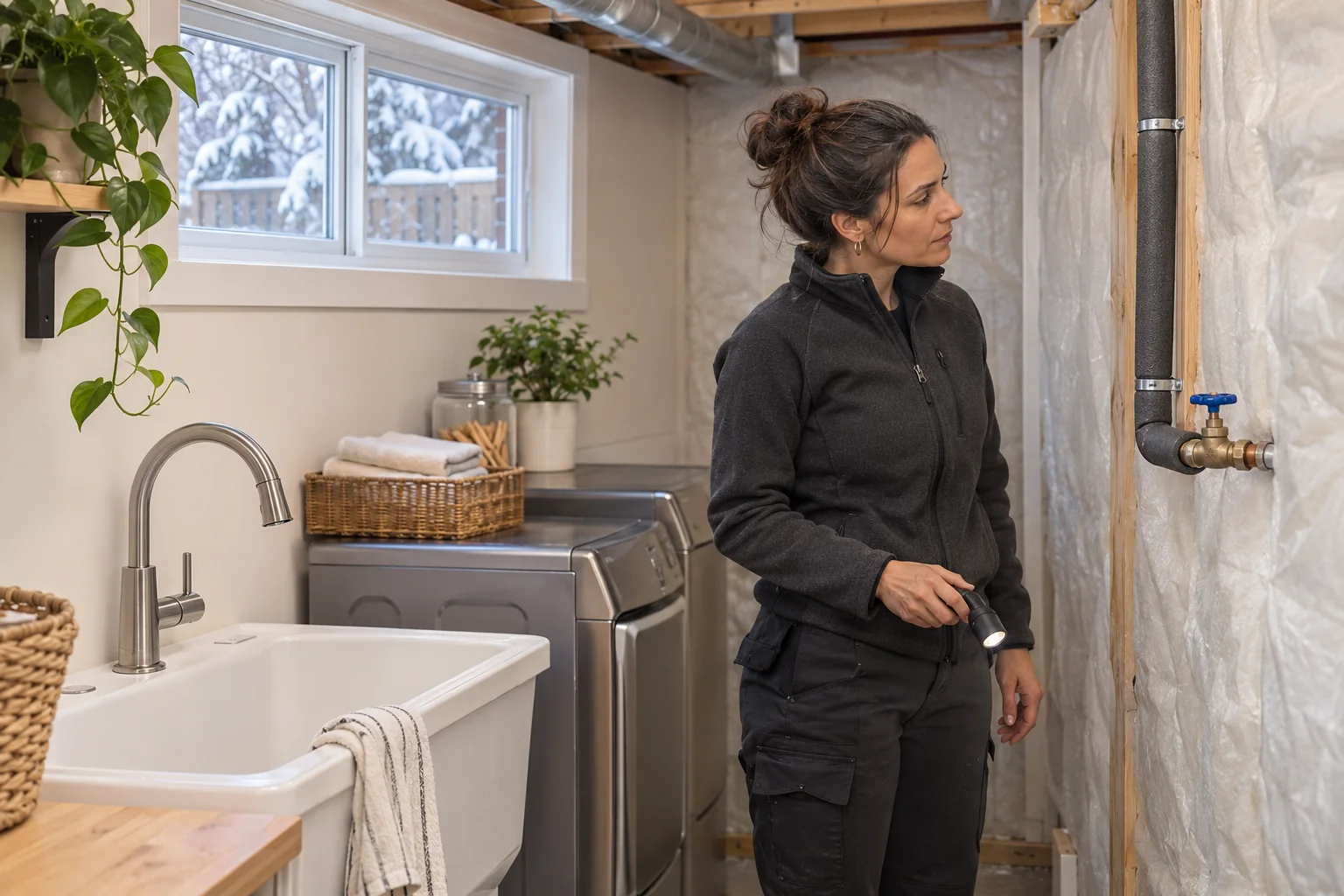
No water in winter: is a frozen pipe blocking the supply, or has water service been interrupted? Cold weather makes freezing a possibility, but it does not establish the cause. A fixture problem, a shut-off inside the building or work on the municipal water system can produce similar symptoms. Start with personal safety, then describe where water is missing and when the change began.
This guide helps you choose whom to contact and prepare useful observations. It is for the resident discovering a dry kitchen tap as well as the manager receiving calls from several apartments. Our frozen and burst pipe service explains professional assistance with the piping. Here, the goal is to make a sound first decision without dismantling plumbing or heating an unidentified section.
Four things to establish first
- Deal with danger first. Water near electrical equipment or a sagging ceiling calls for distance and help.
- Compare the affected taps. One fixture without water differs from an entire building losing its supply.
- Read official notices. A water interruption and a drinking-water advisory provide different instructions.
- Prepare for water to return. Restored flow can reveal a leak and does not explain every remaining restriction.
1. Check for hazards before looking for ice
Look from a dry, stable location. A spreading puddle, water in a light fixture or a ceiling beginning to sag changes the priority. Move occupants away. If water is leaking, close an identified indoor shut-off only when you can reach and operate it safely. Do not force a seized handle. Tell the person taking your call immediately if you cannot isolate the leak.
Hydro-Québec’s water-damage guidance says not to touch the panel unless conditions are fully dry and safe. If you cannot shut off power safely, move away and call 1 800 790-2424. Call 911 if you cannot leave without touching water or energized equipment. Do not restore electricity yourself after water damage; the installation needs professional inspection.
Once people are safe, record what remains visible. Our water-leak first steps guide provides further help with that situation. Photographs can wait. Explaining the hazard and your location matters more than getting a close-up of a wet pipe.
2. Describe the missing supply without repeated tests
If there is no leak, hazard or notice prohibiting water use, briefly compare two or three accessible cold-water taps. Check them one at a time, stay present and close them afterwards. Record “no flow,” “a trickle” or “usual flow.” This comparison describes what you see. It does not measure municipal water pressure or prove that a pipe is frozen.
Also explain what you already know about the hot side without running it for a long test. Water that flows but stays cold is different from no flow through the hot tap. The first situation may concern water heating. The second requires assessment of the supply and distribution path. Winter weather alone does not identify a failed water heater.
Write down the last normal use and when the problem was discovered. “Kitchen worked last night; no cold flow there this morning; bathroom basin still normal” is more useful than “all the plumbing froze.” If a room cannot be checked, say so. You do not need to enter a crawl space or an unsafe mechanical room to complete the record.
3. Treat the pattern as evidence to investigate
The following table helps structure the first call. None of its rows confirms ice or assigns responsibility to the city. Observations, notices and an on-site assessment need to be considered together. Keep a distinction between something you personally checked and something another occupant reported.
| What you observe | Possibility to investigate | Useful next information |
|---|---|---|
| Only one tap has stopped flowing | Fixture, local shut-off or supply branch | Which other taps still work normally? |
| Several nearby fixtures are affected | Shared piping route or cold exposure | Which rooms and hot or cold sides are involved? |
| No cold tap works in the building | Building supply, service line or municipal system | Is there a notice, planned work or another affected property? |
| Water flows but remains cold | Hot-water production or distribution | Is cold-water flow normal elsewhere? |
| Flow returns along with a leak | Damaged piping or connection needing assessment | Where does water appear, and can the shut-off be reached safely? |
Use the same description when speaking with different people. If something changes, add the time and the new observation. A current, specific update is more valuable than repeating an early assumption with increasing confidence.
4. When one fixture or branch has no water
If other taps work, mark the affected fixtures on a simple sketch. Two nearby basins may share a route, but their location alone does not prove that they do. Identify exterior walls, normally heated rooms and recent work. A garage door left open or a noticeable draft is relevant context to pass along.
Do not remove a cartridge, connection or flexible supply tube to see whether water reaches it. A stiff valve or weakened pipe can turn an observation into a leak. Instead, mention recent work under the sink, an announced shut-off or a tap that was already difficult to operate. The professional can decide what should be checked first.
For example, the kitchen sink has lost cold water while an interior bathroom tap works normally. Asking for an assessment of that branch is reasonable. Ordering a replacement underground water service would be premature. Ask the plumber to establish the route and source of the restriction before choosing repairs. Keep any drawings or earlier repair invoices available to support that assessment.
5. When the entire building loses water
Check Montréal’s notices and alerts, in French, using the borough, street and “Eau et aqueduc” subject. Read the affected addresses or street section, the stated period and any updates. A notice for a neighbouring street does not establish that your building is included. Save the link and the time you checked it.
Call Montréal’s 311 to report a general loss of water or request a municipal assessment. A missing online notice does not prove that the network is operating normally. For a property in another municipality, use its local service. Montréal’s arrangements should not be assumed to apply in Laval, an independent island municipality or a city on either shore.
Ask the building manager whether an indoor shutdown is planned or has just taken place. A phone check with a neighbour can add context. Ask whether they recently tried a cold tap, rather than whether they believe they still have water. Neighbours with water cannot rule out a problem affecting your individual service connection.
6. Freezing, low pressure and the water service line
A trickle during cold weather does not establish freezing. Montréal explains that reduced water pressure, in French, can result from work, valve operations or a watermain break, as well as a service-line leak or internal plumbing. Describe the change before naming a component you think needs replacement.
Compare the current behaviour with a period you know. Did it change suddenly, develop gradually or become apparent only when several fixtures were being used? Mention a supply problem that existed before the cold spell. Do not turn a pressure adjustment at random to compensate. Without measurements and knowledge of the installation, that action does not resolve the question of where the problem begins.
Our water service line and shut-off page explains what a more detailed assessment should clarify. The findings should distinguish a measured restriction, an observed leak and a section that remains unverified. Loss of service does not automatically justify excavation. Ask what evidence supports the next proposed step.
7. Know the limits of a thawing attempt
Piping that is hidden, cracked, deformed or close to water and electrical hazards needs professional attention. Do not open a wall to insert a heater. Never use a torch or open flame. The City of Ottawa’s frozen-pipe guidance states this restriction and warns about heat near combustible materials. Its municipal fees and service arrangements do not apply to Montréal.
For an intact indoor section that is visible, accessible and dry, municipal guidance describes gentle warming, including a hair dryer, under continuous supervision. You need to know which pipe is involved, have safe access and keep electrical equipment away from water. Follow the appliance instructions. If those conditions are missing, use the building’s normal heating to warm the room and call for help.
Montréal’s frozen-pipe reporting procedure helps direct the assessment between private and public piping. Stop attempts when flow remains absent or a leak appears. An uncertain result calls for assessment. There is no universal number of hours during which leaving a suspected frozen pipe untreated can be assumed safe.
8. Prepare the right call and safe access
A useful message can be brief: “At this address, these cold taps have had no flow since this time. These are the results from the other apartments actually checked. This is the notice we received, and this is what we can see near the piping.” Add the contact details of the person on site and any access limitations.
Ask who will handle the next step, what information is still needed and how to report a change. Record the municipal request number and the plumbing company contacted. If two parties need to attend, establish who coordinates access and restoration. A first call cannot guarantee the same arrival time or solution at every property.
Requests to close or locate the outside water shut-off, in French, go through the borough. Do not operate it yourself. If a crew is coming, ask how to make access easier without damaging equipment. Clearing a safe route differs from digging around a box, striking ice on it or attempting a municipal shut-off.
9. Apartments, duplexes and condominiums
Notify the owner or manager promptly with dated observations. Identify the apartment, affected fixtures and any leak. Ask who can open the mechanical room and authorize work on common equipment. An occupant should not change a shared shut-off on the assumption that it serves only their own unit.
A shared incident record reduces conflicting messages. The manager can list the apartments actually reached, the time of each check and requests already opened. An apartment whose occupant could not be contacted should remain “not checked.” This prevents a partial interruption from being presented as a confirmed building-wide failure.
For a business, describe which essential uses are affected and explain operating constraints. Keep drinking-water instructions available to the people concerned. Ask the responsible manager to coordinate operating decisions with the appropriate authorities. One tap working again does not replace checking the conditions required for the activity. Someone should also be assigned to communicate changes to the next shift or the person taking over the incident.
10. Manage drinking water and protect appliances
Have bottled water available and match the supply to the people present. Health Canada recommends preparing for at least 72 hours, including two litres of water per person per day, and considering two additional litres for cooking and cleaning. Account for pets and individual needs as well. Store drinking water separately from water reserved for other uses.
For an announced interruption, fill suitable containers before the shutdown begins and keep the supply accessible. If the disruption lasts longer, ask the municipality about drinking-water arrangements. Do not assume a distribution point is already operating because one was available during an earlier event. Confirm the current instructions for the affected area.
Montréal advises avoiding hot-water use during an interruption, in French: heating elements can overheat if a tank empties. Stop water-fed appliance cycles according to their manuals. If a water heater may have drained, get instructions for safe recommissioning before restoring its electrical supply. Do not open electrical covers to investigate. Tell the plumber what happened and which controls, if any, were changed.
11. Loss of heat creates another urgent concern
Report a heating failure, how long it has lasted and which rooms are cooling. Do not calculate a safe waiting period from the outside temperature alone. Pipes experience different conditions depending on their route and the building. If occupants are becoming cold or unsafe, find a heated location and follow municipal directions.
Québec warns about carbon monoxide during outages, in French. Do not heat a home with a barbecue, gas stove or camping appliance. A generator must operate outdoors, away from openings. If the carbon-monoxide alarm sounds, go outside and call 911. Wait for firefighters to authorize re-entry.
If you must leave, tell the owner or professional how to reach you and who can provide access. Ask for a plan suited to the building and its equipment. Closing the water supply alone does not completely drain every pipe and appliance. Arrange a responsible contact instead of assuming that an unoccupied property can safely be left until the next warm day.
12. When water returns, check the advisory as well
Restored flow does not cancel a health advisory. Under a Québec boil-water advisory, explained in French, use bottled water or bring water to a rolling boil for at least one minute for the specified uses, including drinking and brushing teeth. Ordinary household filters do not replace that instruction. Wait for the official notice lifting the advisory.
A do-not-consume notice, in French, and a do-not-use notice, in French, impose different restrictions. Boiling does not cancel them. Read the exact notice and the instructions for returning to normal use. Clear water alone is not proof that it is safe to drink.
Where no incompatible restriction applies, follow Montréal’s discoloured-water instructions, in French: flush with cold water and wait for it to clear before laundry or water-fed appliances. Contact 311 if discolouration persists. Avoid drawing discoloured water into the hot-water tank while checking the cold supply.
13. Record the outcome and prevent a repeat
After the visit, ask what was found, which section was treated and what remains hidden. Clarify the signs requiring a prompt call: new moisture, running-water sounds, another flow restriction or a change near a repaired connection. Keep the report, photographs and municipal reference together. Record any follow-up appointment or instruction before the incident is forgotten.
Montréal’s winter prevention advice, in French, includes keeping the water-entry area accessible and at least 10°C, addressing air leaks and insulating vulnerable pipes. Opening sink cabinets during severe cold can help warm air circulate. Arrange checks of the property during an absence as well.
For a preventive trickle, ask for instructions appropriate to the property, including the tap and duration; make sure its drain flows freely. Follow any directions issued after municipal work. If the same area freezes every winter, ask for an assessment of heating, the building envelope and pipe routing. Thawing restores service. A lasting correction should address the cause actually found.
Frequently asked questions
My neighbours have water. Does that prove my pipe is frozen?
No. Their observations help define the problem but do not identify your defect. Record which properties were checked and when. A closure, restriction or problem on your own connection remains possible. Give that information to the manager, municipal service or plumber without turning it into a diagnosis.
Can I wait for warmer weather if there is no visible leak?
Arrange an assessment promptly. No visible leak does not establish the condition of hidden piping. If water returns while you are away, you may miss a developing problem. Ask what action and monitoring are appropriate instead of deciding on a supposedly safe waiting period yourself.
Should I leave every tap open while I am out?
Do not leave unattended tests running. Identify any open taps and ask the person handling the situation for clear instructions. Preventive flow, supervised thawing and a municipal shutdown are different situations. Record what was left in place and who will check the property, including when responsibility passes to someone else.
What should I ask when the cause remains uncertain?
Ask what the observations or measurements have ruled out, what remains to be checked and what the proposed next step will establish. Clarify who should attend and what changes require an immediate call. A clearly explained provisional finding is more useful than certainty without supporting checks.
Send a clear request
Prepare the address, timing, affected taps, notices received, heating conditions and visible hazards. Call 514 312-3198 for an urgent request to Plomberie LaSalle; availability is confirmed for your address. For planned work, use our Contact page.
Browse our plumbing tips and Plumbing emergencies and water damage category. Official sources consulted November 4, 2026 are linked in the relevant sections. The examples help organize observations; responsibilities and instructions must be confirmed for the particular building and municipality.